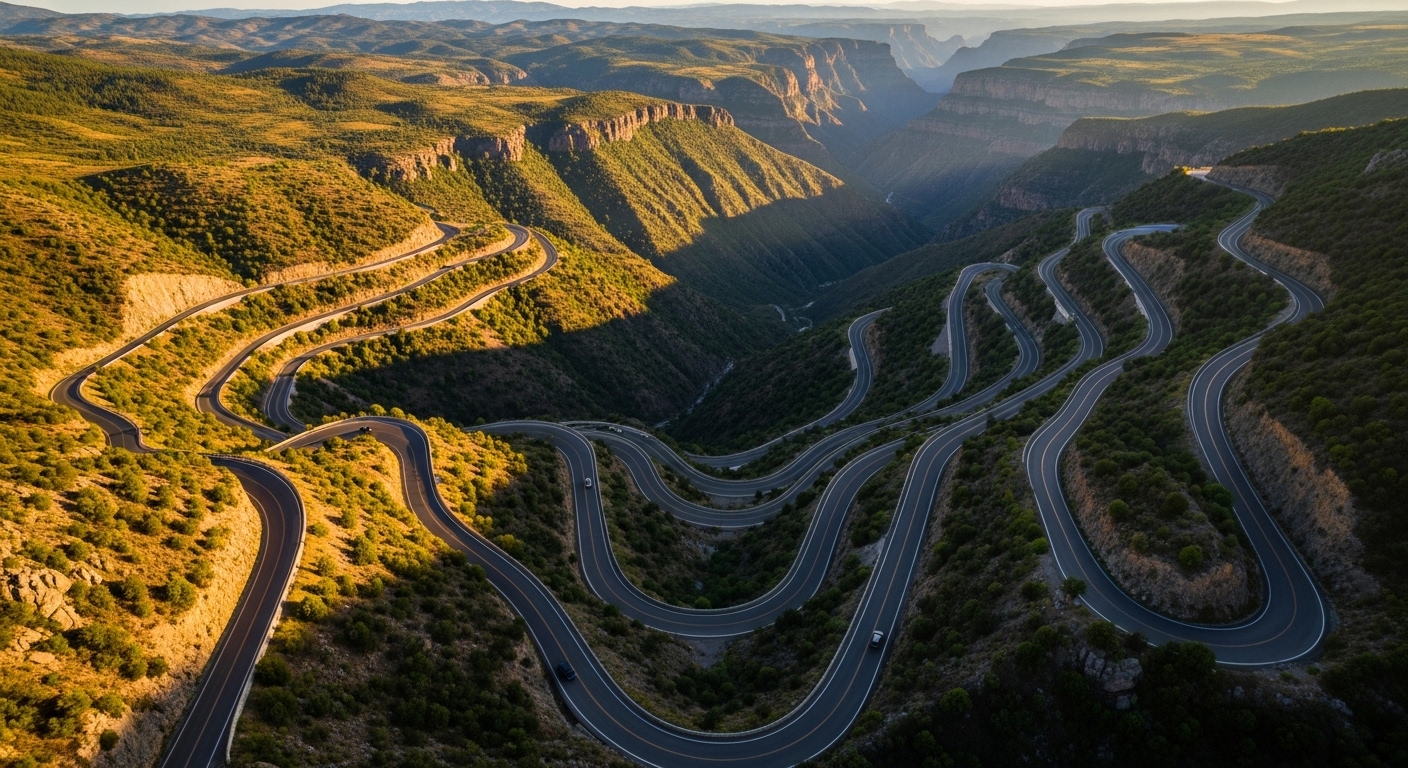
There’s a reason road trip movies never show a straight highway. The drama the freedom lives in the curves. A serpentine road does something a freeway simply cannot: it demands your attention, rewards your skill, and hands you one spectacular view after another as the pavement winds ahead of you like a ribbon dropped from the sky.
But serpentine roads also demand respect. Understanding what they are, how to drive them, and which ones belong on your bucket list is the difference between an unforgettable experience and a white-knuckle ordeal. This guide covers everything from the definition to the technique to the greatest serpentine drives in the United States right now.
What Is a Serpentine Road? A Clear Definition
The word comes from the Latin serpentinus of a serpent. A serpentine road is one that winds continuously in an S-curve pattern, mimicking the movement of a snake across the ground. You’ll find them almost exclusively in mountainous and hilly terrain, where the landscape forces road builders to follow the contours of the land rather than cut straight through it.
Serpentine roads are often confused with switchbacks, but they’re distinct. A switchback reverses direction sharply nearly 180 degrees to gain or lose elevation on steep terrain. A serpentine road flows. It curves left, then right, then left again, with a rhythm that experienced drivers learn to read and anticipate. Many mountain routes combine both elements, but the serpentine stretches are typically the most enjoyable and the most unforgiving of mistakes.
Why Serpentine Roads Demand a Different Kind of Driving
Regular highway driving is largely passive. The road is straight. Corrections are minimal. Your attention can drift. A serpentine road eliminates all of that. Every corner requires an active decision: how fast am I going? Where is my vehicle positioned? What is the road surface doing? Is there anything I can’t yet see?
The physics are different too. When your vehicle corners, centrifugal force pushes it outward. On a tight serpentine bend at speed, that force can overwhelm your tires’ grip limit particularly on a wet road, or where gravel has migrated onto the pavement from the shoulder. The driver who enters a curve too fast discovers, very quickly, that there is no easy correction. The solution is always the same: slow down before the curve, not in it.
Descents on serpentine roads introduce a second risk: brake fade. Long, winding downhill sections generate significant heat in your brake system. Rely too heavily on your brakes and the pads will overheat, losing their effectiveness precisely when you need them most. The correct technique used by professional drivers and taught in advanced driving courses is engine braking: selecting a lower gear and allowing the engine’s resistance to control your speed, preserving the brakes for the moments they’re truly needed.
Driving a Serpentine Road: Technique That Actually Works
Before You Leave
Your vehicle preparation matters more on a serpentine road than on any other route. Check your brake pads mountain roads wear them significantly faster than regular driving. Verify your tire pressure; altitude changes affect it by approximately 0.5 psi per 1,000 feet of elevation gain. Top off your fluids: oil, coolant, brake fluid. Fill your gas tank. On remote serpentine routes, service stations can be many miles apart.
On the Road
The single most important rule on a serpentine road: slow down before the curve, not in it. Braking mid-corner upsets your vehicle’s balance and can cause a slide. Approach each bend with your speed already adjusted, turn in smoothly, accelerate gently through the exit once the road ahead is clear.
Positioning matters. Before a right-hand bend, position toward the left of your lane this widens your sightline around the corner. Before a left-hander, position right. Never cross the center line on blind corners; oncoming traffic on serpentine roads appears faster than you expect. Always yield to uphill traffic on narrow sections where passing is impossible the driver going up has less control and fewer options than the driver descending.
For Motorcyclists
Riders are the most natural serpentine road users and statistically, the most at risk. The technique that separates confident riders from overconfident ones is countersteering: pushing the handlebar on the inside of the turn to initiate lean. Combined with looking through the exit of each corner rather than at the road immediately in front, countersteering allows smoother, faster, safer lines through serpentine curves. Keep your throttle smooth and consistent through the bend. Abrupt inputs mid-corner braking or accelerating sharply destabilize the bike.
America’s Greatest Serpentine Roads in 2026
1. Pacific Coast Highway – California
The 90-mile stretch of California State Route 1 between San Simeon and Carmel-by-the-Sea is the most visually spectacular serpentine drive in the United States. The road curves along sheer coastal cliffs above the Pacific, with pull-outs offering views that photographers have tried and consistently failed to fully capture. It’s accessible year-round, though coastal fog can reduce visibility significantly in June.
2. Million Dollar Highway – Colorado
Route 550 between Silverton and Ouray is 25 miles of alpine serpentine driving that regularly appears on lists of the world’s greatest roads. The road wraps around the San Juan Mountains with hairpin turns, no guardrails on many sections, and sheer drop-offs that concentrate the mind immediately. Historically, the highway cost $1 million per mile to construct hence the name. Fall foliage and summer wildflowers make this route exceptional from June through October.
3. Tail of the Dragon – North Carolina/Tennessee
US Route 129 at Deals Gap is 11 miles containing 318 curves. No driveways. No intersections. Just pure, uninterrupted serpentine road that has made this stretch one of the most celebrated motorcycle and sports car destinations in North America. The road is patrolled, speed-enforced, and attracts enthusiasts from across the country every weekend from spring through fall.
4. Going-to-the-Sun Road – Montana
This 50-mile route through Glacier National Park climbs to Logan Pass at 6,646 feet, with serpentine sections clinging to cliff faces and offering views across the Continental Divide. The road is only fully open from late June to mid-October due to snowpack. Vehicles over 21 feet are prohibited on the upper sections. It is one of the most dramatic drives in North America.
5. Ohio’s Triple Nickel – Route 555
A hidden gem in the Midwest. Route 555 through southeastern Ohio offers relentless hairpin turns, blind crests, and elevation changes through Wayne National Forest. The road attracts sport bike riders and performance car enthusiasts who want the technical challenge of a serpentine road without the long drive west. It’s a local secret that has rapidly become a national destination.
Seasonal Serpentine Driving: What Changes
The same serpentine road can feel completely different across the seasons. In summer, the primary hazards are heat-related brake fade on long descents, increased traffic volume, and gravel washed onto the pavement after storms. Fall brings spectacular foliage but also wet leaves which can be as slippery as ice and earlier nightfall. Spring thaws produce frost-heaved pavement, potholes, and reduced surface grip. Winter transforms many serpentine routes into technical ice driving, requiring winter tires, reduced speeds, and the constant awareness that ice patches form first in shaded sections that dry last.
Check road conditions before every serpentine journey. The National Weather Service provides mountain area forecasts, while most state DOT websites publish real-time road condition reports for major routes.
Serpentine Road Etiquette: What Most Guides Don’t Tell You
Popular serpentine roads attract a wide range of users tourists in rental cars, experienced enthusiasts, motorcyclists, cyclists, and RV drivers. A few etiquette principles make the experience better for everyone. Don’t tailgate the driver ahead may be going exactly the right speed for their skill level and vehicle. Use pull-outs to allow faster traffic to pass safely rather than creating pressure. If you stop for photographs, pull completely off the road; don’t park on the shoulder of a blind bend. And if you experience a mechanical problem, get as far off the road as possible before stopping serpentine bends offer almost no visibility to approaching drivers.
Final Word: The Serpentine Road Mindset
Serpentine roads reward drivers who are present. Not distracted, not rushing, not trying to keep up with whoever is ahead. The drivers who have the best experiences on winding roads are the ones who slow down, look through every corner, and treat the road as the destination rather than an obstacle between two points.
Whether you’re planning your first run along the Pacific Coast Highway or your twentieth lap of the Tail of the Dragon, the principles are the same: prepare your vehicle, respect the physics, read the road ahead, and let the serpentine do what it does best take you somewhere worth going.
Zig Zag Hill Dorset Guide: UK’s Most Twisting Road Explained
Discover why Zig Zag Hill is famous, its sharp bends, scenic views, and what makes it one of Britain’s most unique roads.