
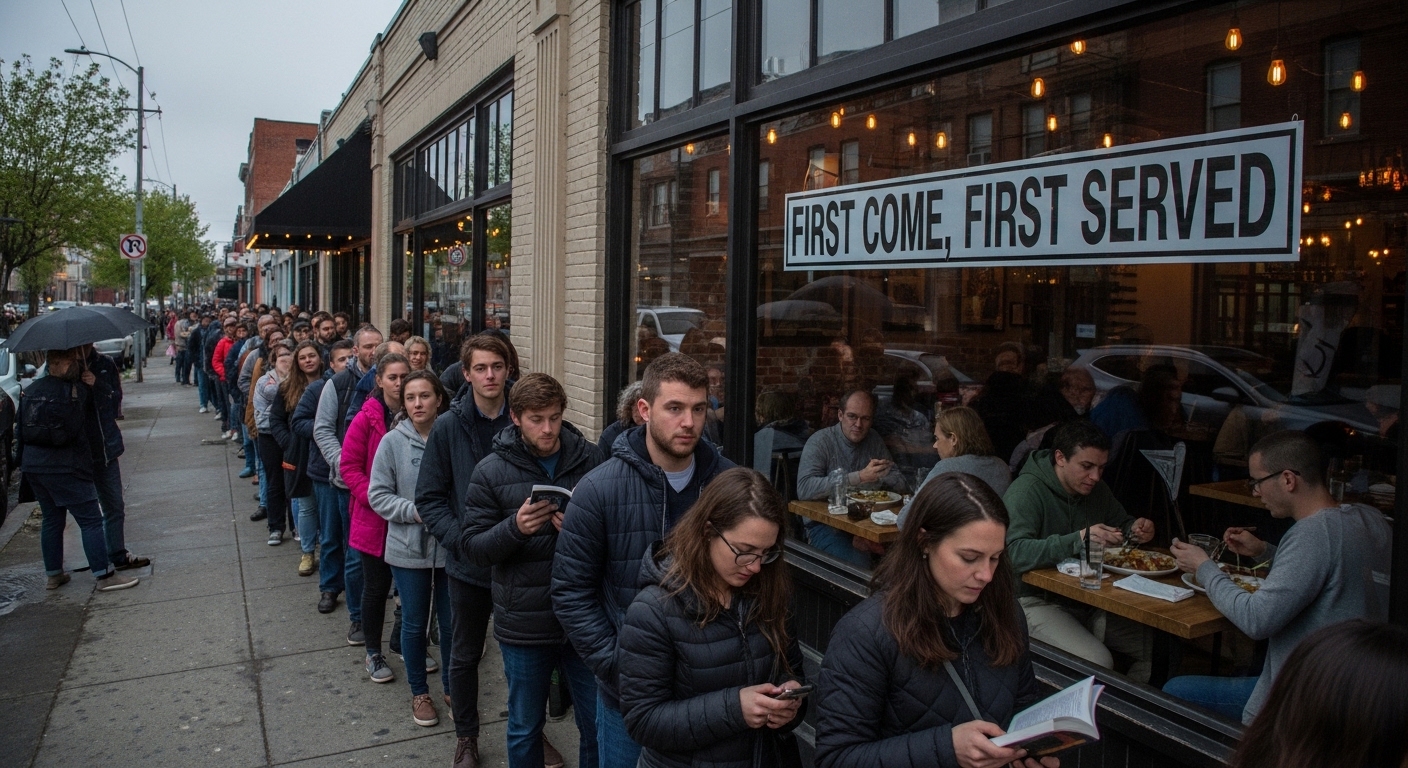
You’ve seen it on a sign at the deli counter. Read it in a concert ticket email. Spotted it in a lease agreement. ‘First come, first served.’ Four words. Simple concept. And yet a surprising number of people spell it wrong, use it incorrectly, or don’t fully understand when it actually applies.
Here’s the thing: first come, first served isn’t just a casual expression. It’s a formal policy framework with roots in 17th-century English law, a starring role in computer science scheduling algorithms, and serious legal implications in housing, water rights, and healthcare. It’s also, as we’ll explore, not always the fairest system even though fairness is its entire premise.
This guide covers everything. The correct spelling and grammar, the full meaning, the historical origin, real-world examples across industries, practical templates you can use today, and a critical look at when the first come, first served model actually fails. Let’s start with the most-Googled question of all.
First Come, First Serve or First Come, First Served? (The Grammar Answer)
Let’s settle this once and for all: the correct phrase is first come, first served.
This isn’t just a style preference it’s a grammatical rule. The phrase is a compressed passive construction that expands to: ‘Those who come first are served first.’ The word ‘served’ is a past participle completing that passive thought. Drop the ‘d’ and the meaning flips entirely: ‘first come, first serve’ technically reads as ‘the first person to arrive is the first person to do the serving’ the exact opposite of what you mean.
According to Merriam-Webster, the phrase means ‘in the order of arrival of people or requests.’ Their entry uses ‘served’ exclusively. The Cambridge Dictionary agrees. So does Collins. The misspelling ‘first serve’ is so common appearing even in publications like The Guardian and The Seattle Times that it’s practically normalized. But in professional writing, HR policies, legal documents, and any formal communication, always use ‘served.’
Hyphenation Rules
Hyphenation depends on where the phrase sits in a sentence:
- Before a noun (compound adjective): Use hyphens. Example: ‘We operate a first-come, first-served policy.’
- After a noun or standing alone: No hyphens needed. Example: ‘Seating is first come, first served.’
The abbreviation FCFS is widely accepted in professional and technical contexts and requires no punctuation.
What Does First Come, First Served Actually Mean?
At its core, first come, first served (FCFS) is a priority system based entirely on arrival order. The first person to request, arrive, or submit gets processed before anyone who comes later regardless of urgency, status, wealth, or social connection.
That last part is crucial. The whole point of an FCFS policy is to eliminate subjective judgment. There’s no favoritism. No VIP lane. No cutting in line because you know the manager. The playing field is leveled by a single objective variable: who got there first.
Cambridge University Press defines it simply as: ‘people will receive something or be dealt with in the order in which they ask or arrive.’ Merriam-Webster adds that it’s used to say ‘the people who arrive earliest get served before those who arrive later.’ In practice, ‘served’ doesn’t just mean food service it covers being processed, allocated a resource, given access, or handled in any way.
The History and Origin of First Come, First Served
The phrase is older than you might think. Its roots trace back to at least the 17th century, appearing in the legal writings of William Lambarde, an English antiquarian and lawyer who documented early common law practices. In those contexts, FCFS was used to describe resource allocation in legal and civic settings establishing who had the right to claim something based purely on the order of their petition.
By the 19th century, shopkeepers had adopted the principle as a customer service philosophy. It was powerful for two reasons. First, it eliminated the appearance of favoritism no one could accuse the butcher of serving wealthy customers ahead of working-class ones when the rule was simply ‘whoever is first in line.’ Second, it created urgency. If you wanted the best selection, you arrived early.
As Economy Wire notes, first come, first served played a particularly significant role during historical scarcity events the Great Depression, wartime rationing, post-war resource distribution where a fair, transparent, and enforceable system for limited goods was a social necessity, not just a business convenience.
The abbreviation FCFS emerged with the rise of computer science in the mid-20th century, as engineers needed a concise way to describe scheduling algorithms. Today, FCFS operates simultaneously as a shopkeeper’s sign policy, a legal allocation doctrine, and a foundational algorithm in operating systems.
First Come, First Served in the Real World: Industry Examples
1. Restaurants and Hospitality
Any establishment without a reservation system operates on a first come, first served basis. Walk-in diners are seated in arrival order. During peak hours, the policy often gets formalized hostesses keep a waitlist and call names strictly by timestamp. The alternative priority seating for regulars or high spenders creates resentment and erodes trust.
2. Event Ticketing
Concert, sports, and theater ticket sales are perhaps the most visible FCFS system in modern life. When tickets go on sale, the first buyers whether online or in person secure access. The best seats often have a first come, first served component even within reserved seating tiers. This drives enormous urgency and early commitment, which benefits event organizers financially.
3. Government Services
DMV offices, passport agencies, public housing authority waitlists, and visa application queues routinely use FCFS. As Dictionary.com examples show, even water rights law in the American West operates on a ‘first come, first served’ doctrine whoever staked a water claim first historically holds senior rights over later arrivals. This principle, called ‘prior appropriation,’ remains active law in many western states today.
4. Healthcare (With Important Exceptions)
General practice clinics and walk-in urgent care centers typically operate on a first come, first served basis. However and this is critical emergency rooms do not. Emergency medicine uses triage, a priority-based system that overrides arrival order based on medical severity. A heart attack victim who arrives after a sprained ankle is treated first. FCFS and triage coexist in healthcare as complementary tools for different contexts.
5. Digital and eCommerce Flash Sales
Online flash sales, limited sneaker drops, and GPU cloud computing resource allocation all operate on FCFS logic. When a retailer announces a limited product release, the first shoppers to complete checkout secure the item. This creates enormous demand concentration in a short window a double-edged sword that drives revenue but also server crashes, bot exploitation, and frustrated customers.
6. Computer Science and CPU Scheduling
In operating systems, FCFS (also called FIFO First In, First Out) is a foundational CPU scheduling algorithm. Processes are executed strictly in the order they enter the ready queue. It’s simple to implement and completely transparent. The tradeoff: the ‘convoy effect,’ where a single long process blocks all shorter processes behind it, dramatically inflating average waiting time.
When First Come, First Served Breaks Down
Here’s what most articles won’t tell you: first come, first served, for all its intuitive fairness, is frequently the wrong policy.
Research from Northwestern University’s Kellogg School of Management, cited by professor Achal Bassamboo, found that first-come-first-served is not always a great approach to call center management. The study showed that customer patience changes over time the longer someone waits, the more likely they are to abandon the queue. A smarter dynamic policy that accounts for individual patience levels outperformed pure FCFS on queue length, abandonment rate, and predicted wait time accuracy across every metric.
This points to a broader truth: FCFS optimizes for simplicity and perceived fairness, not for actual efficiency or equity of outcomes. Consider the structural issues:
- TIME PRIVILEGE: FCFS advantages those with more available time. Standing in line for 6 hours to get concert tickets is possible only if you don’t work a rigid schedule. The policy that appears equal is actually tilted toward people with schedule flexibility.
- THE CONVOY EFFECT: In computing and service queues, one complex request can hold up dozens of simpler ones. A single customer with 47 items holds up the 10 people behind them with 3 items each.
- BOT AND SYSTEM EXPLOITATION: In digital contexts, FCFS is trivially gameable by automated systems. Ticket scalpers use bots to ‘arrive’ milliseconds ahead of real buyers. Sneaker resellers do the same. The policy rewards speed and technical sophistication, not genuine human priority.
- NEED BLINDNESS: A family facing homelessness who discovers a housing waitlist a day late is subordinated to a single individual who signed up earlier. FCFS cannot account for severity of need.
None of this means FCFS is bad it means it’s a tool, and like any tool, it needs to be matched to the right job.
Practical First Come, First Served Templates
One of the most underserved needs in this topic: ready-to-use wording. Here are professional templates for common use cases.
Signage (Retail / Restaurant)
“Seating / Service is provided on a first come, first served basis. No reservations accepted. Thank you for your patience.”
Event / Ticketing Communication
“Tickets are available on a first-come, first-served basis while supplies last. Once capacity is reached, no additional tickets will be sold. We recommend arriving early to secure your spot.”
HR / Workplace Policy
“Conference room reservations are allocated on a first-come, first-served basis through the shared calendar system. Requests submitted earlier will take priority over later submissions for the same time slot.”
Legal / Contract Language
“Applications will be reviewed and approved on a first-come, first-served basis, subject to eligibility requirements. Submission of a complete application does not guarantee allocation; priority is determined solely by the date and time of receipt.”
Email to Customers
“Due to limited availability, access will be granted on a first-come, first-served basis. To secure your spot, please complete your registration by [DATE]. Once capacity is reached, we will be unable to accept additional registrations regardless of interest.”
Frequently Asked Questions About First Come, First Served
Q: Is it ‘first come, first serve’ or ‘first come, first served’?
A: The correct phrase is ‘first come, first served.’ The ‘d’ matters ‘served’ is a past participle meaning the first arrivals are the ones who get served. ‘First serve’ changes the meaning entirely, implying the first person to arrive does the serving. Always use ‘served’ in formal writing.
Q: What does first come, first served mean?
A: It means people or requests are handled strictly in order of arrival. The first person to arrive, submit, or request is the first to receive service, access, or goods regardless of status, urgency, or any other factor. The system is transparent and eliminates favoritism.
Q: When do you hyphenate first come, first served?
A: Hyphenate it (‘first-come, first-served’) only when it directly modifies a noun: ‘a first-come, first-served policy.’ When it stands alone or follows the noun, no hyphens: ‘Seating is first come, first served.’
Q: What is the abbreviation for first come, first served?
A: FCFS is the standard abbreviation. It is also sometimes written FIFO (First In, First Out) in inventory and computing contexts. Both mean the same thing: priority is determined entirely by order of arrival.
Q: What is the origin of the first come, first served phrase?
A: The phrase dates to at least the 17th century, appearing in the writings of English legal scholar William Lambarde. It was widely adopted by shopkeepers in the 19th century as a fairness doctrine and later became a foundational principle in computer science scheduling.
Q: What are the disadvantages of first come, first served?
A: Three key weaknesses: (1) It privileges people with more available time. (2) It creates convoy effects complex early requests delay everyone behind them. (3) In digital contexts, it can be exploited by bots and automated systems that ‘arrive’ faster than humans.
Q: What is FCFS in computer science?
A: FCFS (First Come, First Served) is a non-preemptive CPU scheduling algorithm that executes processes in the order they enter the ready queue. Simple and transparent, but prone to the convoy effect a long process can dramatically inflate average waiting time for all processes behind it.
Q: What is a real-life example of first come, first served?
A: Walk-in restaurants, concert ticket sales, campsite allocation, DMV appointments, flash sales, public housing waitlists, and GPU cloud resource allocation are all common FCFS examples. Emergency rooms are a notable exception they use triage (priority by medical severity) rather than pure arrival order.
The Bottom Line
First come, first served is one of the most durable principles in human organization and for good reason. It’s transparent, intuitive, enforceable, and resistant to favoritism. From 17th-century English law to 21st-century cloud computing queues, the underlying logic hasn’t changed: whoever gets here first has the right to be served first.
But ‘simple’ doesn’t always mean ‘best.’ Knowing when to apply FCFS and when to supplement or replace it with priority-based systems, triage models, or merit-based allocation is the real skill. The phrase isn’t just a sign on a deli counter. It’s a policy decision, a fairness philosophy, and sometimes a legal doctrine.
Use it correctly (first come, first served, with the ‘d’), apply it thoughtfully, and know its limits. That’s how a four-word policy earns long-term trust.
Viral Slang
Bomboclat Meaning — What It Really Means on TikTok & Online
This viral word isn’t just random slang. Learn its real meaning, origin, and why people use it in memes.