
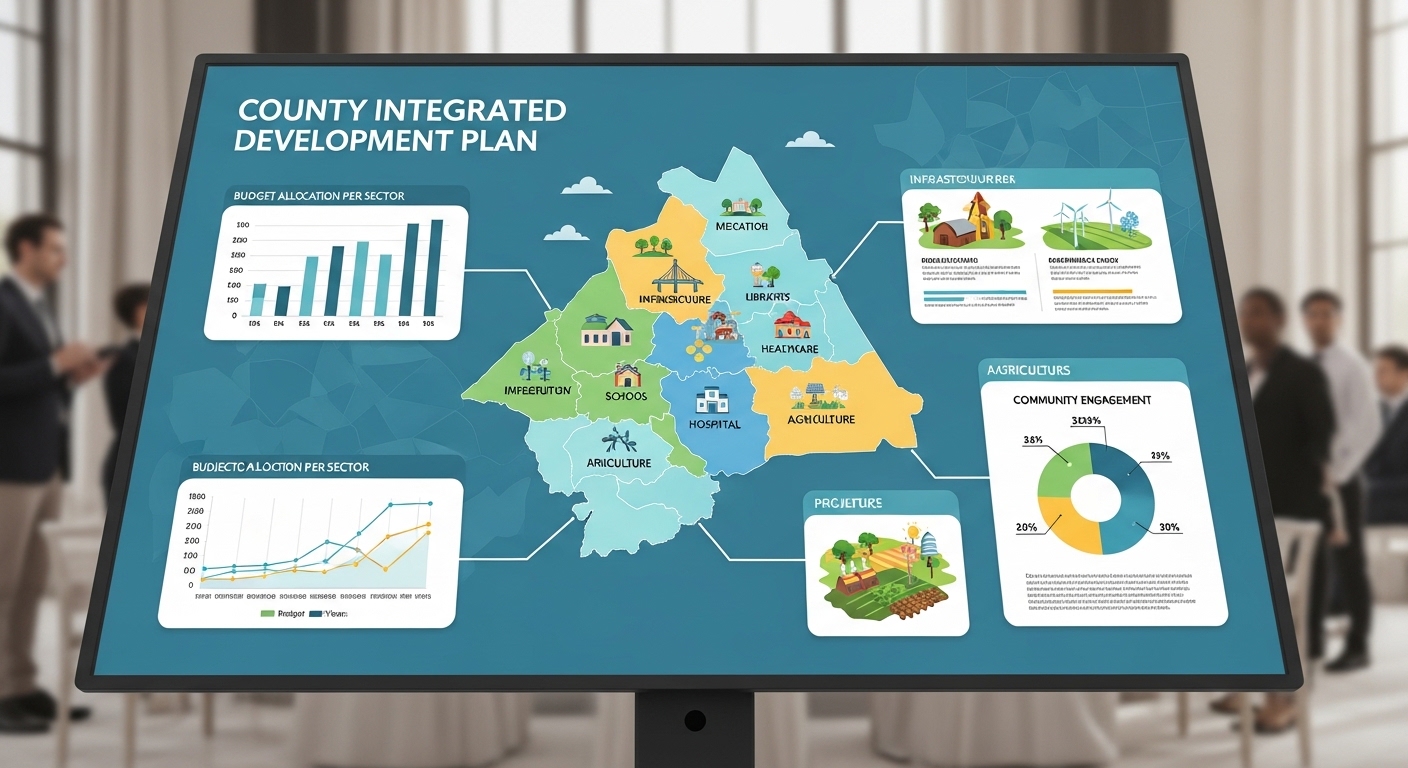
Local governments carry one of the hardest jobs in public service. They’re responsible for roads, water, housing, health services, economic growth, and community wellbeing all at the same time, all on a budget that never feels big enough. And they have to do it across communities with wildly different needs, priorities, and expectations.
That’s where the County Integrated Development Plan comes in.
If you’ve ever wondered why some counties grow in a way that actually makes sense where infrastructure, services, and investment all seem to move in the same direction the answer usually starts with a well-built IDP. This guide breaks down everything you need to know: what a County Integrated Development Plan actually is, why it matters, how it gets built, and how you as a citizen can engage with it.
What Is a County Integrated Development Plan? (Definition)
A County Integrated Development Plan (IDP) also referred to as a County Integrated Development Plan (CIDP) is a five-year strategic planning document used by local and county governments to guide all development decisions, resource allocation, and service delivery within their jurisdiction.
It integrates social, economic, environmental, spatial, and institutional planning into one unified framework. Rather than letting departments operate in silos roads doing one thing, health doing another, housing doing something else entirely the IDP ties all of those threads together under a single, agreed-upon development direction.
In plain terms: it’s the master plan that tells a county where it’s going, what it’s going to build and fund, and how it’s going to measure whether any of it actually worked.
The IDP is not a new concept. In South Africa, it has been a legal requirement under the Municipal Systems Act of 2000, which mandates that all municipalities develop and regularly review their plans. In Kenya, the County Governments Act requires every county government to prepare a CIDP as part of the devolved governance framework established under the Constitution. Other jurisdictions across Africa and beyond have adopted similar frameworks under different names. The underlying idea is the same everywhere: coordinated, accountable, community-driven planning.
Why Do Counties Need an Integrated Development Plan?
Some people look at an IDP and see a bureaucratic document. That’s a mistake. Here’s what it actually does in practice.
It creates legal accountability. In jurisdictions where an IDP is legally required, county governments cannot spend public money on development projects without tying that spending to the plan. This creates a paper trail that communities, oversight bodies, and watchdog organizations can use to hold leadership accountable.
It aligns the budget with real priorities. Without a plan, budgets get shaped by whoever shouts loudest or sits closest to power. With a CIDP in place, there’s a documented, publicly consulted set of priorities that budget allocations are expected to reflect. Misalignment between the IDP and the annual budget is itself a red flag that citizens and auditors can act on.
It coordinates services across departments. Roads need water infrastructure. Water infrastructure affects where housing gets built. Housing shapes where schools go. None of these decisions should happen in isolation and the IDP is the mechanism that forces them to talk to each other.
It attracts investment. Investors, development agencies, and donor organizations want to know that a county has a clear, coherent development direction before they commit funds. A well-prepared CIDP signals institutional credibility. According to the World Bank’s governance research, counties with structured long-term development frameworks are significantly more likely to attract both public and private investment.
It puts communities on the map. When a county’s priorities are documented, residents in underserved areas can point to the plan and ask why their ward wasn’t funded. That’s not just transparency it’s democratic accountability in action.
Key Components of an Integrated Development Plan
Not every IDP looks exactly the same, but the strong ones share a common architecture. Here’s what a well-structured County Integrated Development Plan should contain:
1. Situational Analysis This is the diagnostic foundation of the entire plan. It covers the county’s demographic profile, economic conditions, existing infrastructure, social service gaps, environmental context, and institutional capacity. A quality situational analysis includes both quantitative data (population figures, poverty rates, infrastructure deficits) and a SWOT assessment that honestly identifies where the county is underperforming.
2. Vision, Mission, and Development Objectives What is the county trying to become over the next five years? This section answers that question with specific, measurable language not vague aspirational statements. The vision should be ambitious enough to inspire but grounded enough to actually guide decision-making.
3. Strategies and Programs This is where the plan gets specific. Based on the situational analysis, what strategies will the county use to close development gaps? How will those strategies be organized into programs and interventions? This section should connect directly to departmental work plans and implementation timelines.
4. Spatial Development Framework Where things get built matters as much as what gets built. The spatial component of the IDP maps out land use priorities, growth corridors, conservation areas, and settlement patterns. It prevents the kind of uncoordinated sprawl that costs counties far more in infrastructure down the road.
5. Financial Plan and Budget Alignment An IDP without a realistic funding plan is just a wish list. This component outlines how the county will finance its priorities through local revenue, national transfers, donor funding, public-private partnerships, and other mechanisms. It also sets out multi-year expenditure projections and links specific programs to budget lines.
The IDP Development Process: Phase by Phase
Creating a County Integrated Development Plan isn’t something that happens in a weekend. It’s a structured, multi-month process that’s supposed to involve the whole county government and citizens alike.
| Phase | Activity | Timeline |
|---|---|---|
| Phase 1 | Process Planning Set up the process framework, assign roles, establish participation structures | Month 1 |
| Phase 2 | Analysis Situational assessment, data collection, community profiling | Months 2–3 |
| Phase 3 | Strategies Develop vision, objectives, and strategic interventions | Months 3–4 |
| Phase 4 | Projects and Integration Identify specific projects, link to budget, integrate sector plans | Month 5 |
| Phase 5 | Approval and Adoption Public review, council approval, official adoption | Month 6 |
After adoption, the IDP doesn’t just sit on a shelf. It should be the reference point for every annual development plan, every departmental budget, and every performance report the county produces. Regular mid-term reviews and end-of-term evaluations are standard practice in well-run systems.
Who Are the Key Stakeholders in the IDP Process?
The IDP is designed to be participatory meaning it shouldn’t be written by a small technical team and handed down from above. The following groups all have a legitimate role in shaping the plan:
County Council and Mayor’s Office carry the legal authority to adopt the IDP and are responsible for ensuring the process happens on time and in compliance with applicable law.
Ward Representatives and Councilors serve as the primary conduit between communities and the planning process. They’re expected to bring community concerns to the table and communicate plan decisions back to residents.
Business and Private Sector Organizations bring an economic development lens. They can flag investment barriers, identify growth opportunities, and often contribute to financing priorities identified in the IDP.
Civil Society and NGOs represent voices that formal government structures sometimes miss marginalized communities, people with disabilities, youth, women, and informal settlement residents. Their participation makes the plan more inclusive and more legitimate.
Provincial and National Government provide policy frameworks, funding mandates, and alignment requirements. County IDPs in most jurisdictions must demonstrate alignment with national development plans and sectoral policies.
Development Partners and Donor Agencies in counties that receive external funding often require IDP alignment as a condition of support. Their participation can bring both resources and technical capacity to the process.
How Citizens Can Participate in the IDP Process
This is one of the most underused aspects of the entire IDP system and it’s one of the most important. Here’s how ordinary residents can meaningfully engage.
Attend IDP public participation meetings. County governments are required to hold community consultations during the planning process. These meetings are open to the public, and they’re one of the few formal moments when residents can directly influence what goes into the plan. Show up, bring specific concerns, and put them on record.
Submit written inputs through ward committees. Most county systems have ward-level structures that feed into the IDP process. Written submissions even a short letter outlining your community’s needs become part of the official participation record.
Engage your ward councilor directly. Your elected representative is accountable to the IDP process. If your community’s priorities aren’t showing up in the draft plan, that’s a conversation to have with your councilor before the plan is adopted, not after.
Monitor implementation progress reports. After adoption, counties are typically required to publish annual implementation reports. Read them. Compare what was promised in the IDP to what actually got funded and built. Gaps between plans and budgets are the clearest signal of governance problems.
Use the IDP as an accountability tool. The plan is a public document. When a county government fails to deliver on what the IDP commits to, citizens and civil society organizations can formally raise it through oversight committees, audit processes, or community accountability forums.
Common Challenges in IDP Implementation
Even well-designed plans run into implementation problems. The most common ones are worth knowing about.
Budget misalignment is probably the most widespread issue. A county produces a strong IDP with clear priorities, then the annual budget reflects different choices often politically driven ones. When the budget and the IDP don’t match, the IDP becomes irrelevant in practice.
Weak community participation happens when public consultations are treated as box-ticking exercises rather than genuine engagement. If residents don’t trust that their input matters, turnout drops, and the plan ends up reflecting the preferences of whoever was in the room which is rarely the community at large.
Capacity constraints affect smaller and lower-resourced counties disproportionately. Preparing a quality IDP requires data analysis skills, planning expertise, and project management capacity. Many county governments simply don’t have enough of those capabilities in-house.
Lack of political will shows up when elected leaders treat the IDP as a compliance requirement rather than a genuine governing tool. When leadership changes, new priorities can quietly push the existing IDP aside without any formal revision process.
Monitoring and evaluation gaps mean that even when things go wrong during implementation, nobody catches it in time to course-correct. An IDP without a functioning M&E system is a plan without a feedback loop.
IDP vs. Other Planning Frameworks: How Does It Compare?
The IDP isn’t the only local planning framework in the world. Here’s how it stacks up against similar tools in other jurisdictions.
| Framework | Jurisdiction | Duration | Key Focus |
|---|---|---|---|
| IDP / CIDP | South Africa, Kenya, and others | 5 years | Integrated local development social, economic, spatial, institutional |
| Comprehensive Plan | United States | 20+ years | Land use, zoning, and long-term growth management |
| Local Development Plan | United Kingdom | 15 years | Spatial planning and land use policy |
| Municipal Master Plan | India | 10–20 years | Urban growth, infrastructure, and land use |
The key distinction that makes the IDP unique is its integration mandate. A U.S. Comprehensive Plan focuses primarily on land use. A Local Development Plan in the UK is heavily spatial. The IDP is designed to pull social services, economic development, infrastructure, environmental management, and institutional performance into a single strategic framework with budget alignment built in. That breadth is both its strength and its complexity.
Real-World Examples of IDP Success and Failure
What good looks like: Some of Kenya’s better-performing counties have used their CIDPs to systematically attract development partner funding by demonstrating planning rigor. When a county can show a credible five-year framework with clear priorities, measurable targets, and a functioning M&E system, organizations like the United Nations Development Programme and bilateral donors are far more likely to direct resources there.
What poor execution looks like: The most common failure pattern is a county that produces a technically impressive IDP with detailed situational analysis, ambitious targets, and comprehensive sector strategies and then submits an annual budget that funds something completely different. When planning and budgeting are disconnected, the IDP exists only as a document. No amount of planning sophistication fixes an accountability gap that wide.
The lesson across both contexts is the same: the quality of an IDP matters less than the institutional culture around it. A plan only delivers results if leadership actually uses it to make decisions.
Frequently Asked Questions About the IDP
Q: What does IDP stand for in local government? IDP stands for Integrated Development Plan. In county contexts, it’s often referred to as the CIDP County Integrated Development Plan. Both terms refer to the same type of five-year strategic planning document used by local governments.
Q: Is an IDP legally required? In many jurisdictions, yes. In South Africa, the Municipal Systems Act of 2000 makes IDP preparation a legal obligation for all municipalities. In Kenya, the County Governments Act requires each of the 47 counties to prepare a CIDP. Legal requirements vary by country, but the trend in devolved governance systems is toward mandatory integrated planning.
Q: How often is an IDP reviewed? Most IDP frameworks require a full review every five years, aligned with the local government electoral cycle. Many systems also require annual reviews to assess implementation progress and make adjustments based on changed circumstances or performance data.
Q: How is the IDP linked to the municipal budget? The IDP is supposed to be the primary driver of budget decisions. Departments should be allocating resources to programs and projects that appear in the IDP, not inventing priorities independently. In practice, annual budgets should explicitly reference IDP priorities, and any significant deviation should require formal justification.
Q: Can residents change what’s in the IDP? Residents can influence the IDP through formal public participation processes during drafting, and they can advocate for revisions during annual review periods. The IDP can’t be changed unilaterally by individual citizens it requires council approval but sustained community pressure, formal submissions, and ward-level advocacy have shaped plans in meaningful ways in well-functioning systems.
Final Thoughts
A County Integrated Development Plan is one of the most powerful tools in local governance when it actually works. It forces governments to make choices in public, justify those choices against community needs, and then deliver on commitments in a way that can be tracked and audited.
The key word is integrated. The IDP isn’t just a list of projects. It’s a framework that connects diagnosis to strategy, strategy to budget, and budget to accountability. When that chain holds together, counties develop in a way that makes sense where the road goes where the people are, where the clinic gets funded before the crisis, and where citizens have a real say in what their community becomes.
That’s the promise of the what is county integrated development plan framework. Holding governments to that promise is everyone’s job.
Matarecycler AI — Smart Recycling Powered by Technology
Learn how AI is transforming recycling and making waste management smarter, faster, and eco-friendly.