
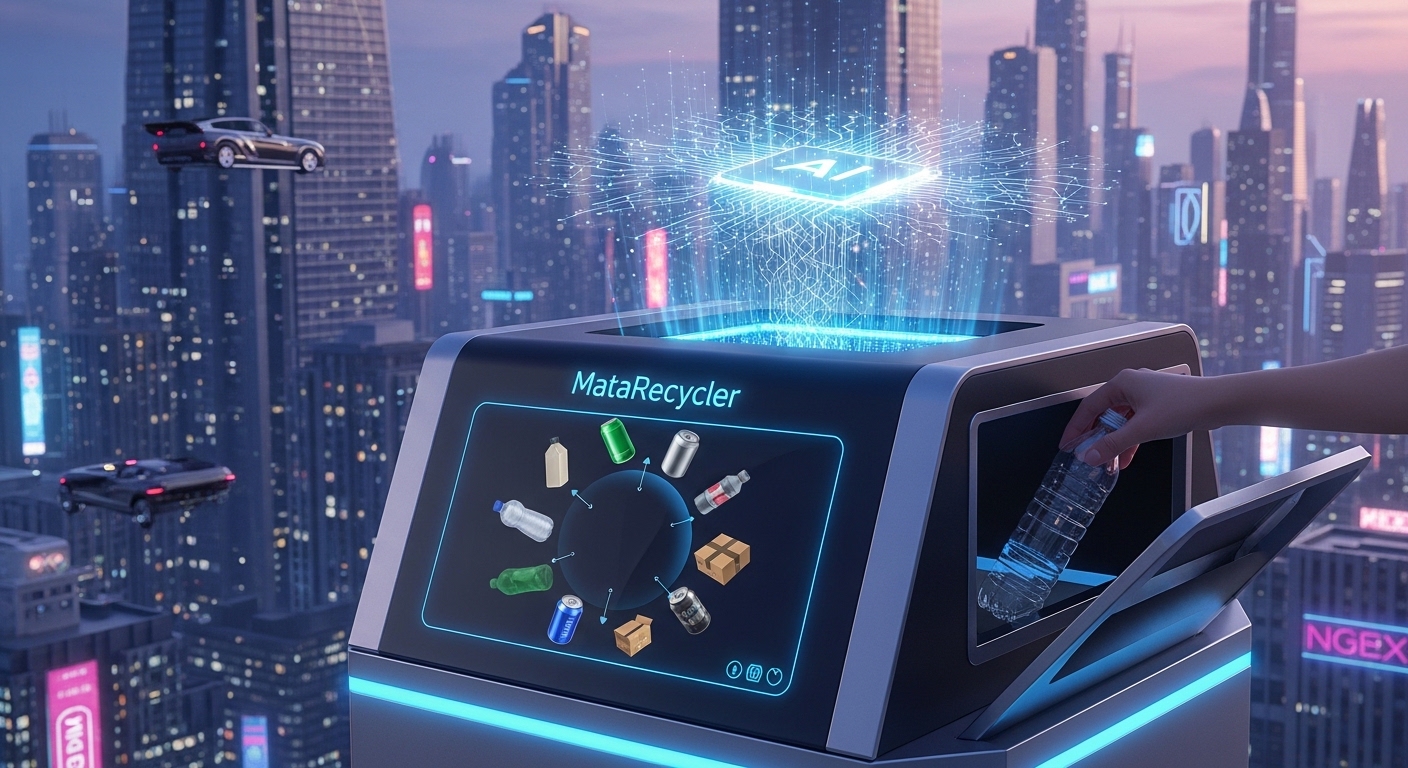
What Is MataRecycler?
Recycling has always had a simple premise: keep useful materials out of the trash. For decades, the execution never matched the intention. Bins overflow. Labels confuse people. Contamination ruins entire loads. Good intentions end up in landfills anyway.
MataRecycler is a direct response to that failure.
At its core, MataRecycler is an AI-powered smart recycling platform that connects smart bins, material-recognition software, real-time sensors, and a mobile app into a single integrated system. It is not a single device or a standalone machine. It is an ecosystem one designed to fix every weak point in the traditional recycling chain, from the moment someone drops a bottle in a bin to the moment that material gets recovered and reused.
The system is built for everyone. Cities can deploy it at scale across public infrastructure. Businesses use it to hit sustainability targets with verifiable data. Schools run it as both a practical tool and a teaching platform. Households use the app to stop guessing whether something is actually recyclable. The common thread running through all of it is intelligence specifically, AI that learns, adapts, and improves with every interaction.
In 2026, that kind of intelligence is no longer a luxury upgrade for recycling programs. It is becoming a baseline requirement. The numbers make that argument impossible to ignore.
The Real Problem With Old Recycling Systems
Here is the uncomfortable truth about traditional recycling: most of it does not work the way people think it does.
The EPA reports that Americans produce roughly 292 million tons of solid waste every year about 4.9 pounds per person per day. Of that massive volume, only around 32% is actually recycled or composted. The rest goes to landfills or gets incinerated. Globally, the numbers are even worse. The World Bank estimates that just 13.5% of all waste generated worldwide gets properly recycled. In low and middle-income countries, that number drops close to zero in some areas.
The problem is not that people refuse to recycle. The problem is that the systems built to support recycling are fundamentally broken in several interconnected ways.
Contamination is the primary killer. When even a single non-recyclable item ends up in a recycling bin a greasy pizza box, a plastic bag, a coffee cup with residue it can contaminate an entire batch of otherwise recoverable material. Traditional facilities estimate contamination rates as high as 25% in manual sorting operations. That means one in four loads has to be rejected. It goes to the landfill anyway, and the effort invested in collecting it is wasted.
Rule confusion drives incorrect sorting. Recycling guidelines vary by city, county, and country. A plastic container that is accepted in one city is rejected 30 miles away. People cannot be expected to memorize local rules that change without notice. So they guess. And when they guess wrong, contamination follows.
Static systems cannot keep pace with changing packaging. Modern packaging involves layered materials, bio-based plastics, mixed composites, and dozens of polymer types that traditional optical sorters were never designed to identify. When packaging evolves faster than sorting technology, the gap between what should be recycled and what actually gets recycled grows wider every year.
Collection is inefficient and wasteful. Garbage trucks run fixed routes whether bins are full or nearly empty. That is fuel burned, labor paid, and emissions generated for no recovery benefit. Without real-time monitoring, waste collection is a scheduling guess rather than a data-driven operation.
MataRecycler was built to address every single one of these failures simultaneously.
How MataRecycler Works Step by Step
Understanding MataRecycler is easier when you trace a single piece of waste through the entire system. Here is exactly what happens.
Step 1 The Scan Happens at the Point of Disposal. When someone approaches a MataRecycler-equipped bin, they either use the mobile app to scan the item or drop it directly into a smart bin. The bin’s embedded cameras and sensors activate immediately. The AI analyzes the item in real time reading its shape, texture, color, chemical composition, and contextual clues like label fragments or size and classifies it within seconds.
Step 2 The AI Makes a Sorting Decision. Based on that classification, the system routes the item to the correct stream or flags it as contamination. In home setups, the app displays an AR overlay guiding the user to the right bin. In commercial or municipal facilities, robotic arms handle physical sorting automatically. The decision is made faster than any human sorter could manage and with consistent accuracy that does not drop when volumes increase.
Step 3 The Bin Monitors Itself. IoT sensors inside the smart bin continuously track fill levels, usage patterns, and contamination incidents. When a bin approaches capacity, the system sends an alert directly to collection teams. This is not reactive it is proactive. Collection only happens when it is actually needed, not on a fixed calendar schedule.
Step 4 Data Gets Uploaded to the Cloud. Every scan, every sort, every collection event is recorded. That data feeds a central dashboard accessible to city planners, facility managers, sustainability officers, and school administrators. They can see waste volume trends, recycling rates, contamination hotspots, and collection efficiency metrics in real time, from any device, from anywhere.
Step 5 The System Learns and Improves. Every interaction trains the machine learning models. A material that was difficult to classify in Week 1 becomes easier to identify by Week 8. Over time, accuracy improves, contamination decreases, and recovery rates climb. This self-improving loop is what separates MataRecycler from any static, rule-based system the longer it runs, the better it gets.
AI Sorting: How It Identifies Different Materials
The intelligence inside MataRecycler is not a single algorithm checking items against a fixed database. It is a layered system that reads multiple signals simultaneously to make classification decisions much the way a trained human eye would, but faster and without fatigue.
Computer Vision is the first layer. High-resolution cameras capture the item from multiple angles. The AI evaluates shape, surface texture, color variation, and structural geometry. It can distinguish between clear PET plastic and cloudy HDPE even when both look similar to the human eye. It can read a partial label, recognize standard packaging formats, and identify materials even when they are crumpled, dirty, or partially obscured.
Near-Infrared (NIR) Spectroscopy provides the chemical fingerprint. Different materials absorb and reflect infrared light in distinct patterns. NIR sensors identify the specific polymer type of a plastic, distinguish between different glass compositions, and separate paper grades based on fiber structure. This is how the system separates PET-1 from PET-3 a distinction that matters enormously for downstream processing but is invisible to the naked eye.
Machine Learning Classification ties it all together. The AI has been trained on massive datasets covering thousands of material types, packaging formats, and contamination scenarios. When it sees a new item, it compares what it observes against everything it has learned and assigns the classification with the highest statistical confidence. When confidence is low, it flags the item for manual review rather than making a wrong call.
Contextual Pattern Recognition allows the system to handle real-world complexity. A crumpled aluminum can does not look like the clean, cylindrical can in a training dataset. But the AI recognizes enough consistent signals material reflectance, density indicators, structural fragments to classify it correctly. Even packaging with no visible label can be identified through material composition alone.
The result is sorting accuracy that consistently exceeds 95%, with specialized setups reaching 98% under controlled conditions. Human sorters on a busy shift typically reach 85–90% accuracy on good days and that rate drops as volumes increase and fatigue sets in. The AI does not get tired. It does not have bad days.
Real Data: How Much Waste Is Saved With AI Sorting?
This is the section most articles skip entirely. The philosophy sounds compelling but what do the actual numbers look like? Here is what the data shows.
Global AI recycling analytics firm Greyparrot detected and analyzed over 52 billion waste objects across 65 global recovery facilities in 2025 a significant jump from 40 billion objects tracked in 2024. Their data showed that average recoverable plastic ending up in residue lines (material that gets landfilled instead of recycled) fell from 3,000 tonnes per facility in 2024 to 2,500 tonnes in 2025. Sorting facilities are processing growing plastic volumes more efficiently than at any previous point.
That improvement has direct emissions consequences. Every tonne of recycled PET plastic produces approximately 79% less carbon than manufacturing the same amount from virgin material. When AI sorting recovers material that previously would have gone to landfill or incineration, those savings are real and measurable.
The broader industry data is equally compelling. According to research compiled from multiple AI recycling implementations, ML-powered sorting solutions operate approximately 80% faster than manual or partially automated systems. AI and robot-based sorting boosts overall material recovery facility efficiency by up to 50%. IoT smart bin sensors reduce overflow incidents by more than 30% while simultaneously cutting unnecessary collection trips. Route optimization driven by AI sensor data reduces fuel costs by 10–15% per fleet.
Contamination reduction numbers are particularly striking. AI utilization leads to a 20% reduction in plastic contamination in sorted recyclables. AI-driven waste segregation reduces landfill contributions by approximately 22%. In trials specifically, throughput has been boosted by as much as 70%, cutting waste and increasing material recovery simultaneously.
At the facility level, the adoption of AI in recycling operations can reduce operational costs by 25%. AI-based optimization in collection logistics reduces transportation costs by up to 20%. For a mid-sized city running a conventional waste collection program, those percentages translate to millions of dollars annually.
The AI in waste management market reflects this momentum. Valued at approximately $3.5 billion in 2023, it is projected to reach $15.9 billion by 2031 at a compound annual growth rate of 20.8%. That growth rate is not speculative. It tracks with documented deployments across Europe, North America, and Asia where results are already measurable.
One concrete example from the school sector: a mid-sized U.S. city that implemented smart recycling technology in its school system recorded a 60% increase in recycling rates. A European manufacturer that adopted IoT sensors and AI sorting reduced contamination by 85% and saved approximately €100,000 annually in fines and fees. In a growing Asian community where NGO partnerships introduced smart bins at the neighborhood level, participation rates climbed from 30% to 75%.
The data is not theoretical. It is operational.
Smart Bins How Sensors Reduce Collection Costs
The smart bin is where MataRecycler becomes visible in the physical world, and it does considerably more than just hold waste.
Each bin is fitted with a combination of sensors: fill-level detectors that measure how full the bin is in real time, material-type identifiers that flag contamination at the point of disposal, and connectivity hardware that transmits data continuously to the central platform. When the bin reaches a set capacity threshold, an automated alert goes to the collection team. No more scheduled pickups that find half-empty bins. No more overflowing bins that sit unattended over a weekend because the route was not scheduled.
That shift from calendar-based collection to data-driven collection sounds minor. The cost savings are not. Fewer unnecessary truck trips means less fuel burned, fewer driver hours paid, and lower vehicle wear. Across a city operating hundreds of collection vehicles, the cumulative savings over a year are substantial. IoT monitoring directly enables those savings by making collection responsive rather than rigid.
The contamination flagging at the bin is equally valuable. When the system identifies a non-recyclable item being deposited, it can alert the user in real time through the app. That immediate feedback loop educates users faster than any awareness campaign can. People learn what they did wrong at the exact moment they did it and they retain that learning.
For facility managers, the bin-level data creates visibility that previously did not exist. You can see which locations generate the most contamination. You can identify neighborhoods or building types that need additional education. You can spot patterns certain item types that consistently confuse users and adjust guidance accordingly. That targeted, data-driven approach to behavior change is far more effective than generic recycling campaigns.
The Mobile App Features Breakdown
The MataRecycler mobile app is the human interface for a system that would otherwise be invisible to most users. It translates AI sorting intelligence into guidance that anyone can act on without technical training.
Material Scanning is the most-used feature. Point the camera at any item and the app identifies it, classifies it by material type, and tells you exactly how to dispose of it based on local recycling rules. This is not a generic database lookup it is location-aware guidance that adapts to wherever you are. The same plastic container might be recyclable in your city and rejected three towns over. The app knows the difference.
AR Disposal Guidance overlays sorting instructions directly onto the camera view. Instead of reading a list of rules, you see exactly where to put the item you are holding. For households with multiple bins or complex sorting requirements, this visual guidance eliminates the uncertainty that leads to contamination.
Personal Recycling Dashboard tracks your history. It shows how many items you have correctly recycled, how much material has been diverted from landfills through your actions, and what your estimated carbon impact looks like over time. Seeing those numbers accumulate is a surprisingly effective motivator for sustained behavior change.
Community Challenges and Gamification turn recycling into a social activity. Neighborhoods compete for recycling rates. Schools run sustainability challenges. Families share achievements. The competitive element taps into the same psychology as fitness apps progress becomes visible, shareable, and worth pursuing.
Educational Content is embedded throughout. Every material classification comes with a brief explanation of why it is classified that way what happens to it after collection, why contamination matters, and what the environmental stakes look like. This is not lecturing. It is contextual learning that arrives exactly when the user is engaged and receptive.
Reward System issues MataPoints for each correct scan and properly sorted item. Points can be redeemed through partnerships with local businesses or converted into community sustainability credits. The reward system addresses one of the most persistent barriers to recycling adoption: the lack of any personal incentive beyond vague environmental goodwill.
MataRecycler vs Other Smart Recycling Solutions
This comparison does not exist anywhere else with this level of specificity. Here is how MataRecycler stacks up against the primary alternatives in the smart recycling space.
MataRecycler vs AMP Robotics
AMP Robotics is one of the most widely deployed AI sorting systems in U.S. material recovery facilities. Over 500 robotic units are operational in American and European MRFs. AMP’s strength is large-scale facility automation it is built primarily for high-volume industrial sorting operations. MataRecycler operates across a broader ecosystem, connecting individual users through the mobile app to the same data infrastructure that powers facility-level sorting. AMP is an enterprise-grade B2B industrial tool. MataRecycler bridges the gap between consumer behavior and facility operations.
MataRecycler vs Greyparrot AI
Greyparrot is a waste analytics platform that excels at giving recycling facilities and brands unprecedented visibility into what is flowing through their systems. It tracked over 52 billion waste objects globally in 2025 and can identify 111 distinct waste categories. Its primary use case is data intelligence for facility managers and packaging producers. MataRecycler overlaps on the analytics side but extends further into user-facing features the app, the rewards system, the community engagement layer. Greyparrot is a facility-intelligence platform. MataRecycler is a full-stack recycling ecosystem that includes facility intelligence but also addresses individual user behavior.
MataRecycler vs TOMRA Systems
TOMRA is a Norwegian company with AI sorting deployed in over 80 countries, specializing in deposit return systems and high-precision sorting for beverage containers. Their NIR spectroscopy and deep learning technology is world-class for specific material streams. But TOMRA’s systems are purpose-built for specific material categories within controlled facility environments. MataRecycler is more generalist designed to handle mixed waste streams across diverse deployment environments, from individual households to large municipal programs.
MataRecycler vs Traditional Smart Bin Providers (Bigbelly, Ecube Labs)
Smart bin providers like Bigbelly and Ecube Labs focus primarily on fill-level monitoring and collection optimization. They solve the overflow and collection efficiency problem effectively. What they do not address is AI material sorting, contamination detection, user education, or the rewards and engagement layer. MataRecycler incorporates smart bin functionality as one component of a broader system that also handles everything those standalone bin providers leave unaddressed.
| Feature | MataRecycler | AMP Robotics | Greyparrot | TOMRA | Smart Bins Only |
| AI Material Sorting | ✅ | ✅ | ✅ | ✅ | ❌ |
| Consumer Mobile App | ✅ | ❌ | ❌ | ❌ | ❌ |
| Smart Bin Sensors | ✅ | ❌ | ❌ | ❌ | ✅ |
| Rewards/Gamification | ✅ | ❌ | ❌ | ❌ | ❌ |
| Facility Analytics Dashboard | ✅ | ✅ | ✅ | ✅ | Limited |
| Residential Use Case | ✅ | ❌ | ❌ | ❌ | ✅ |
| Blockchain Integration | In Development | ❌ | ❌ | ❌ | ❌ |
| Best For | Full ecosystem | Industrial MRFs | Analytics & Brands | Container recovery | Overflow prevention |
Benefits for Homes, Businesses, Schools & Cities
For Households
The app eliminates the guesswork that causes most residential recycling mistakes. Instead of checking a confusing list of local rules, users scan the item and get an immediate answer. Over time, the feedback loop teaches correct sorting habits without requiring anyone to study. The rewards system creates a tangible incentive for participation that vague environmental messaging never delivers. And the dashboard makes the cumulative impact of daily recycling decisions visible turning abstract sustainability values into concrete, personal numbers.
For Businesses
Corporate sustainability reporting has become a serious compliance requirement. ESG metrics, investor expectations, and regulatory frameworks all demand verifiable data on waste reduction and recycling rates. MataRecycler provides exactly that a real-time data trail documenting recycling performance across every location, sortable by time period, material type, and contamination rate. That data supports regulatory reporting, investor communications, and supply chain sustainability commitments. One documented example: a European manufacturer reduced contamination by 85% and cut associated fines and fees by approximately €100,000 annually after deploying the system.
For Schools
Schools are where recycling habits get formed. When students learn correct sorting at school, those habits transfer home. MataRecycler turns the school environment into a living sustainability lab the app becomes a classroom tool, the smart bins become interactive learning stations, and the community challenges create engagement that standard curriculum cannot replicate. A 60% increase in school recycling rates in a documented U.S. city deployment shows what this looks like in practice.
For Cities
Municipal governments face a brutal combination of rising waste volumes, stricter environmental regulations, tightening budgets, and increasing public expectations around sustainability. MataRecycler addresses all four simultaneously. Fill-level monitoring cuts collection costs by eliminating unnecessary truck runs. AI sorting reduces the contamination that causes recovered material to be rejected. The data dashboard supports long-term waste planning, policy decisions, and sustainability reporting. And the community engagement layer drives the behavioral change that infrastructure upgrades alone cannot achieve.
Challenges of Scaling Smart Recycling in Developing Countries
This section exists nowhere else in the MataRecycler content landscape. It needs to.
The honest conversation about smart recycling technology has to include the places where it is hardest to deploy because that is where the waste problem is most severe and the gap between technology potential and ground reality is widest.
The Infrastructure Gap Is Fundamental
Smart recycling systems require reliable electricity, internet connectivity, and smartphone penetration to function at full capability. In sub-Saharan Africa, Latin America, and significant parts of South and Southeast Asia, all three of those prerequisites are inconsistent or unavailable in many areas. A smart bin that relies on cellular data transmission is useless in a neighborhood without stable cell coverage. A mobile app that assumes smartphone ownership excludes the populations who may need waste management improvements most urgently.
Research on circular economy implementation in Global South countries consistently identifies infrastructure limitations as the primary barrier not lack of interest, not cultural resistance, but basic physical prerequisites that do not exist. Recycling rates in Latin America, the Caribbean, sub-Saharan Africa, and Central Asia remain below 3% for many material categories, partly because the collection infrastructure that would make recycling possible simply is not there.
The Cost Barrier Is Real
Smart bins, AI sorting systems, and the hardware required to run sensor networks involve upfront capital costs that are difficult to justify in low-income municipal contexts. Research on sub-Saharan African waste management indicates that building large-scale recycling and recovery technology infrastructure requires an estimated $6 to $42 billion across the region. That is not a funding gap that technology companies can close alone. It requires public investment, development financing, NGO partnerships, and policy frameworks that create economic incentives for private sector participation.
The Informal Sector Complication
In many developing countries, waste management is already handled informally. Waste pickers, informal recyclers, and small-scale scrap traders form an existing ecosystem that processes significant volumes of recyclable material. In India, more than 95% of e-waste is processed informally, often in conditions that are hazardous to workers. In Ghana’s Agbogbloshie district, massive quantities of e-waste are burned to recover metals, releasing toxic emissions in the process.
Smart recycling technology that ignores or displaces this informal sector creates more problems than it solves. The more effective approach and the one that systems like MataRecycler will need to embrace to operate effectively in these contexts is integration rather than replacement. Giving informal workers access to app-based identification tools, connecting their collections to formal processing channels, and providing data that lets municipalities track informal sector activity alongside formal collection are all approaches that can amplify what already works rather than competing with it.
Connectivity-Light Deployment Models
The path forward for developing country deployment involves designing for constrained infrastructure rather than assuming full connectivity. This means offline app functionality that caches local recycling rules without requiring constant data connection. It means solar-powered smart bins that operate independently of grid electricity. It means SMS-based notification systems as fallbacks where smartphone penetration is low. It means modular systems that cities can deploy in phases as infrastructure improves, rather than requiring full-system deployment from day one.
The opportunity is real and the urgency is genuine. Getting the deployment model right for diverse infrastructure contexts is one of the most important technical and policy challenges that smart recycling technology faces in the next decade.
Future: Blockchain Integration & Reward Programs
The trajectory of MataRecycler points clearly toward deeper integration with two technologies that are still emerging in the recycling sector: blockchain and expanded reward ecosystems.
Blockchain for Transparency and Verification
The core problem with recycling claims is verification. A company can state that it diverted X tons of material from landfill. A city can publish a recycling rate. But without an immutable, tamper-proof record of what was actually collected, sorted, and processed, those claims are difficult to independently verify. That matters enormously as ESG reporting requirements tighten and recycling credits become tradable financial instruments.
Blockchain integration gives every transaction in the MataRecycler ecosystem every scan, every sort, every collection event, every processing record a permanent, auditable entry in a distributed ledger. That creates recycling credentials that are verifiably real. For corporate sustainability reporting, it transforms recycling data from a claimed metric into a certified one. For municipalities, it creates an incorruptible record for environmental compliance reporting.
The connection to Extended Producer Responsibility (EPR) legislation is direct. As the EU’s Packaging and Packaging Waste Regulation 2025/40 mandates recycled content in all primary packaging by 2030, and as similar regulations develop in the U.S. and other markets, brands and packaging producers need verified data on how their materials perform in real-world sorting systems. Blockchain-verified recycling records from a system like MataRecycler become a compliance asset, not just an operational metric.
Expanded Reward Ecosystems
The current MataPoints reward system is the beginning of a much larger possibility. As blockchain integration matures, recycling points can become tradable digital tokens tied to verified environmental impact. Users who recycle consistently and correctly accumulate tokens with actual market value, redeemable not just at partner businesses but potentially exchangeable for carbon credits, utility bill offsets, or direct cash equivalents.
This is not science fiction. Pilot programs connecting verified recycling behavior to financial rewards already exist in several markets. MataRecycler‘s combination of AI verification, IoT tracking, and blockchain recording creates the infrastructure needed to make those programs scalable and credible.
Carbon tracking is another near-term addition. Each correctly sorted material has a calculable carbon benefit the difference between its emissions footprint as recycled input versus virgin material. Making that number visible to individual users, in the same dashboard where they track their recycling history, connects daily behavior to the climate outcomes that motivate many people’s interest in recycling in the first place.
The future of MataRecycler is not just smarter sorting. It is a fully connected ecosystem where verified environmental action generates verified economic value and where the gap between good intentions and measurable impact closes permanently.
FAQs
What is MataRecycler in simple terms?
MataRecycler is a smart recycling system that uses artificial intelligence, IoT sensors, and a mobile app to make recycling more accurate, more efficient, and easier for everyone from individual households to large cities. It identifies materials automatically, monitors bins in real time, reduces contamination, and tracks environmental impact with verifiable data.
How accurate is the AI sorting in MataRecycler?
AI-powered sorting systems within platforms like MataRecycler consistently achieve accuracy rates above 95%, with specialized configurations reaching 98% under controlled conditions. For comparison, human sorters typically reach 85–90% accuracy under good conditions and that rate drops as volumes and fatigue increase.
Does MataRecycler work without a smartphone?
The mobile app provides the richest user experience, but the system’s smart bins operate independently of individual user devices. Bins monitor fill levels and contamination automatically, and collection alerts are sent directly to operations teams regardless of whether individual users engage with the app.
Can small cities or towns afford to deploy MataRecycler?
The modular nature of the system allows for phased deployment. A city can start with smart bins in high-traffic areas and expand coverage as budgets allow. The collection cost savings from IoT monitoring often offset a portion of the deployment cost within the first operating year.
How does MataRecycler handle recycling rule differences between cities?
The app’s material guidance is location-aware. It references local recycling guidelines for wherever the user is located. This means the same item might generate different disposal instructions in different cities which is correct, because local processing infrastructure genuinely varies.
Is MataRecycler data private?
The system collects data about recycling patterns and bin usage. Individual user data is associated with accounts that users control. Aggregate anonymized data is used to improve sorting algorithms and support municipal planning. Responsible data governance transparency about what is collected and how it is used is a stated priority of the platform.
How does the reward system work?
Users earn MataPoints for each correctly scanned and sorted item. Points accumulate over time and can be redeemed through partner businesses or converted into sustainability credits. As blockchain integration develops, those points are expected to gain expanded exchange value tied to verified environmental impact.
What happens to the materials after MataRecycler sorts them?
Sorted materials go to appropriate downstream processing: plastic to polymer reprocessors, metals to smelters, paper to fiber mills, organics to composting or anaerobic digestion. The higher the sorting accuracy, the higher the quality of recovered material and the more likely it is to actually enter manufacturing cycles rather than being downcycled or landfilled.