
Powerball numbers were drawn again last Saturday 24, 25, 39, 46, 61, and a red Powerball of 1. No jackpot winner stepped forward. The prize rolls to $87 million for Monday, April 21, 2026. And somewhere across America, millions of people are doing the same thing: fishing a ticket out of their wallet, lining up their numbers, and feeling that strange, specific mix of hope and math. That’s the Powerball experience. Every Monday, Wednesday, and Saturday, it plays out the same way.
But if you’ve ever wondered exactly how Powerball numbers work what the red ball actually does, how the prize tiers break down, what realistic odds look like across all nine winning combinations you’re in the right place. This guide covers everything: the latest results, the complete prize structure, the real math, lump sum versus annuity, and the all-time biggest jackpots in history.
Latest Powerball Numbers: April 18, 2026
| Drawing: Saturday, April 18, 2026
White Balls: 24 • 25 • 39 • 46 • 61 Powerball Number: 1 Power Play: 5x Jackpot Result: No winner Jackpot rolls to $87 million Next Drawing: Monday, April 21, 2026 at 11:00 PM ET |
Two tickets worth $1 million each were sold in New York and Oregon matching all five white balls without the Powerball number. With the Power Play option active at 5x, players who added Power Play to those tickets walked away with $2 million instead. The prior drawing on Friday, April 17, saw numbers 38, 43, 44, 49, 62 with a Powerball of 8.
Always confirm results on the official Powerball com website or your state lottery’s page. Results posted here are accurate as of publication but should be verified before making any claims.
What Is the Powerball Number? (A Clear Explanation)
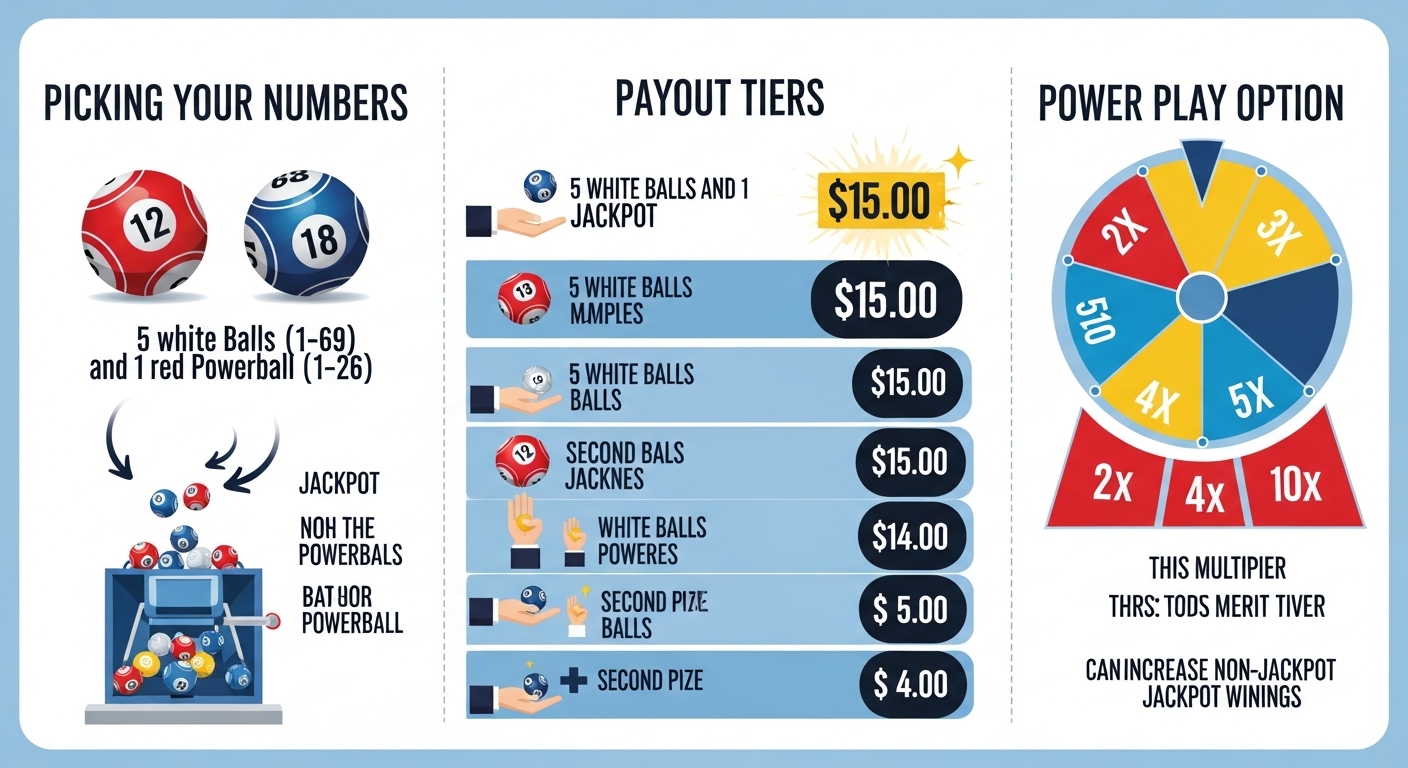
The game uses two separate pools of numbered balls. Five white balls are drawn from a drum of 69. One red ball the Powerball number is drawn separately from a drum of just 26. That’s why you see Powerball results written as five numbers plus one: for example, 24-25-39-46-61 • Powerball: 1.
The Powerball number is the game’s most important single ball. Without it, you cannot win the jackpot, no matter how many white balls you match. But matching it alone even without any white balls still wins you $4.
The distinction matters for strategy, too. If you add the optional Power Play upgrade ($1 extra per ticket), the Powerball number interactions determine part of your multiplied payout. Match five white balls with Power Play? You win $2 million automatically. Miss the Powerball number but match four white balls? You’re looking at $100, multiplied by whatever the Power Play number is that night.
All 9 Prize Tiers: What Every Combination Wins
One of the most misunderstood aspects of Powerball is that there are nine ways to win, not just the jackpot. Here’s the complete breakdown:
| Match | Prize | Odds (per ticket) | With Power Play |
| 5 + Powerball | Jackpot | 1 in 292,201,338 | Jackpot (not multiplied) |
| 5 white balls | $1,000,000 | 1 in 11,688,053.52 | $2,000,000 (auto) |
| 4 + Powerball | $50,000 | 1 in 913,129.18 | Up to $250,000 |
| 4 white balls | $100 | 1 in 36,525.17 | Up to $500 |
| 3 + Powerball | $100 | 1 in 14,494.11 | Up to $500 |
| 3 white balls | $7 | 1 in 579.76 | Up to $35 |
| 2 + Powerball | $7 | 1 in 701.33 | Up to $35 |
| 1 + Powerball | $4 | 1 in 91.98 | Up to $20 |
| Powerball only | $4 | 1 in 38.32 | Up to $20 |
The overall odds of winning any prize across all nine tiers are 1 in 24.87. That’s far better than the jackpot odds, and it explains why millions of players enjoy the game regularly even if they never hit the big number
How the Powerball Number Draw Actually Works
Each drawing is conducted live under strict security protocols. Two separate lottery machines are used simultaneously one for the white balls, one for the red Powerball. The machines are gravity-pick style, meaning numbered rubber balls are circulated by air pressure and one ball at a time is released up a tube into the display window.
Before each drawing, a Power Play number (2, 3, 4, 5, or 10) is separately drawn. The 10x multiplier is only available when the advertised jackpot is $150 million or less. Drawings are conducted and certified by independent auditing firms. According to the Multi-State Lottery Association (MUSL), which administers Powerball, security procedures include pre-draw equipment testing, ball weight and diameter checks, and official certifications for each draw.
The drawing takes place at 11:00 p.m. Eastern Time every Monday, Wednesday, and Saturday. The cutoff for ticket sales is 10:00 p.m. ET, though some individual states enforce an earlier cutoff always check your local lottery’s rules.
Lump Sum vs. Annuity: The Honest Math
If you win the Powerball jackpot let’s use the current $87 million as our example you don’t actually receive $87 million. Here’s how the math actually works.
Cash option (lump sum): The lump sum is approximately 50–60% of the advertised jackpot. For an $87 million prize, the cash value is roughly $39 million. From there, the IRS withholds a mandatory 24% for federal taxes, and winners owe additional tax at their marginal rate when they file. In the highest bracket (37%), the effective federal take is about 37%. State taxes vary. A rough estimate: after all taxes, a winner collecting the lump sum on an $87 million jackpot might net $22–26 million.
Annuity option: The annuity pays the full advertised $87 million over 30 payments (29 years), with each payment increasing 5% annually. The total money received is higher than the lump sum, but payments are taxed as income in each year received.
Most financial advisors recommend the lump sum if you are financially disciplined and can invest wisely, because the long-term compounded return on $39 million invested well can exceed the annuity total. But this is a deeply personal decision. If you’re ever in the position to make it, consult a fee-only financial advisor before signing anything.
The Biggest Powerball Jackpots in History
The jackpot starts at $20 million and rolls over every drawing that doesn’t produce a winner. Because Powerball is offered across 45 states, Washington D.C., Puerto Rico, and the U.S. Virgin Islands, the player pool is enormous and jackpots can grow staggeringly large.
Here are the five largest Powerball jackpots ever won:
- $2.04 billion- November 7, 2022. Won by Edwin Castro, a single ticket sold at a gas station in Altadena, California. The largest lottery prize in world history. Castro took the lump sum of $997.6 million.
- $1.787 billion – September 6, 2025. Split between two winning tickets in Missouri and Texas after 41 consecutive drawings without a jackpot winner. Each winner took the cash option of $410.3 million.
- $1.765 billion – October 11, 2023. A single winning ticket sold at Midway Market and Liquor in Frazier Park, California. Claimed by a group represented by Theodorus Struyck.
- $1.586 billion – January 13, 2016. Three winning tickets in California, Tennessee, and Florida split the then-record jackpot. Each winner received over $520 million before taxes.
- $1.326 billion – April 7, 2024. Cheng ‘Charlie’ Saephan of Oregon won the jackpot, sharing it with his wife and a friend who went in on the ticket purchase.
What these wins have in common: many were won by ordinary people a guy who went to work the day after winning, a Boeing employee inspired by the last 747 delivery, a group that called themselves “The Breakfast Club.” Powerball jackpots change lives in ways that are difficult to fully anticipate.
Hot and Cold Powerball Numbers: What the Data Actually Means
Third-party lottery statisticians track how frequently each Powerball number and white ball has appeared over hundreds of drawings. So-called ‘hot numbers’ have appeared more often than statistical expectation; ‘cold numbers’ have appeared less often.
Here’s the honest truth: this data is interesting but strategically meaningless. Each drawing is completely independent. The machines have no memory. A ball that was drawn last Saturday has exactly the same probability of being drawn this Saturday as any other ball. This is called statistical independence, and it applies universally to all Powerball draws.
That said, some players use frequency data as a starting point for number selection and there is nothing wrong with that as a matter of personal preference. Just don’t mistake pattern recognition for predictive power. The odds are the odds, regardless of history.
Responsible Play: A Note Worth Including
Powerball is one of the most popular forms of entertainment in the United States. Tens of millions of people buy tickets each week, and for most of them, the $2 price tag buys something real: a few days of ‘what if’ thinking, a shared office pool conversation, a reason to watch the news on a Wednesday night. That entertainment value is real even when the numbers don’t match.
But lottery play should always be approached as entertainment with a known cost not as a financial strategy or investment. The expected value of a $2 Powerball ticket is negative in virtually all jackpot scenarios. If you or someone you know is spending beyond entertainment limits on lottery tickets, the National Council on Problem Gambling (ncpgambling.org) provides free, confidential support and resources.
Frequently Asked Questions About Powerball Numbers
Q: What is the Powerball number?
The Powerball number is the single red ball drawn from a pool of 26. It is drawn separately from the five white balls. You must match it to win the jackpot, but matching it alone wins $4.
Q: What were the last Powerball winning numbers?
April 18, 2026: 24, 25, 39, 46, 61 Powerball: 1. Power Play: 5x. No jackpot winner. Next draw: Monday, April 21, 2026. Jackpot: $87 million. Always verify at Powerball.com.
Q: What are the odds of winning the Powerball jackpot?
1 in 292,201,338 per $2 ticket. The overall odds of winning any prize are 1 in 24.87. There are 9 prize tiers, with the minimum prize being $4 for matching just the Powerball number.
Q: How does Power Play affect Powerball number winnings?
Power Play multiplies non-jackpot prizes by 2x, 3x, 4x, 5x, or 10x (when the jackpot is under $150 million). Matching 5 white balls with Power Play automatically pays $2 million instead of $1 million.
Q: What does matching only the Powerball number win?
Matching only the red Powerball number (no white balls) wins $4. With a 5x Power Play, that becomes $20. Odds: 1 in 38.32 per ticket.
Q: Should I take the Powerball lump sum or annuity?
The lump sum is roughly 50-60% of the advertised jackpot, then taxed further. The annuity pays more total money over 29 years with 5% annual growth. Most financial advisors recommend consulting a professional before choosing.
Q: When are Powerball numbers drawn?
Every Monday, Wednesday, and Saturday at 11:00 p.m. Eastern Time. Ticket sales close at 10:00 p.m. ET (some states close earlier). Results are posted immediately after each drawing at Powerball.com.
Q: Is Quick Pick better than choosing my own Powerball numbers?
Statistically, no every number combination has equal odds of winning. About 70-80% of jackpot winners used Quick Pick, but that reflects how most tickets are purchased, not any advantage. Choose based on personal preference.
Conclusion
Understanding how Powerball numbers work all six of them, all nine prize tiers, the real odds, the lump sum math, and the Power Play mechanics doesn’t make you more likely to win. Nothing does. But it does make the experience clearer, more rational, and ultimately more enjoyable.
The jackpot sits at $87 million for Monday’s drawing. Three drawings a week, 292 million-to-one odds, and somewhere out there is the one ticket that will match all six numbers. Until then, the game continues, the balls keep tumbling, and the ‘what if’ stays alive which, for most players, is the whole point.
Who Is La Fonda Sue Honeycutt? Full Story & Key Details Explained
Discover the background, life details, and why La Fonda Sue Honeycutt is gaining attention online.