
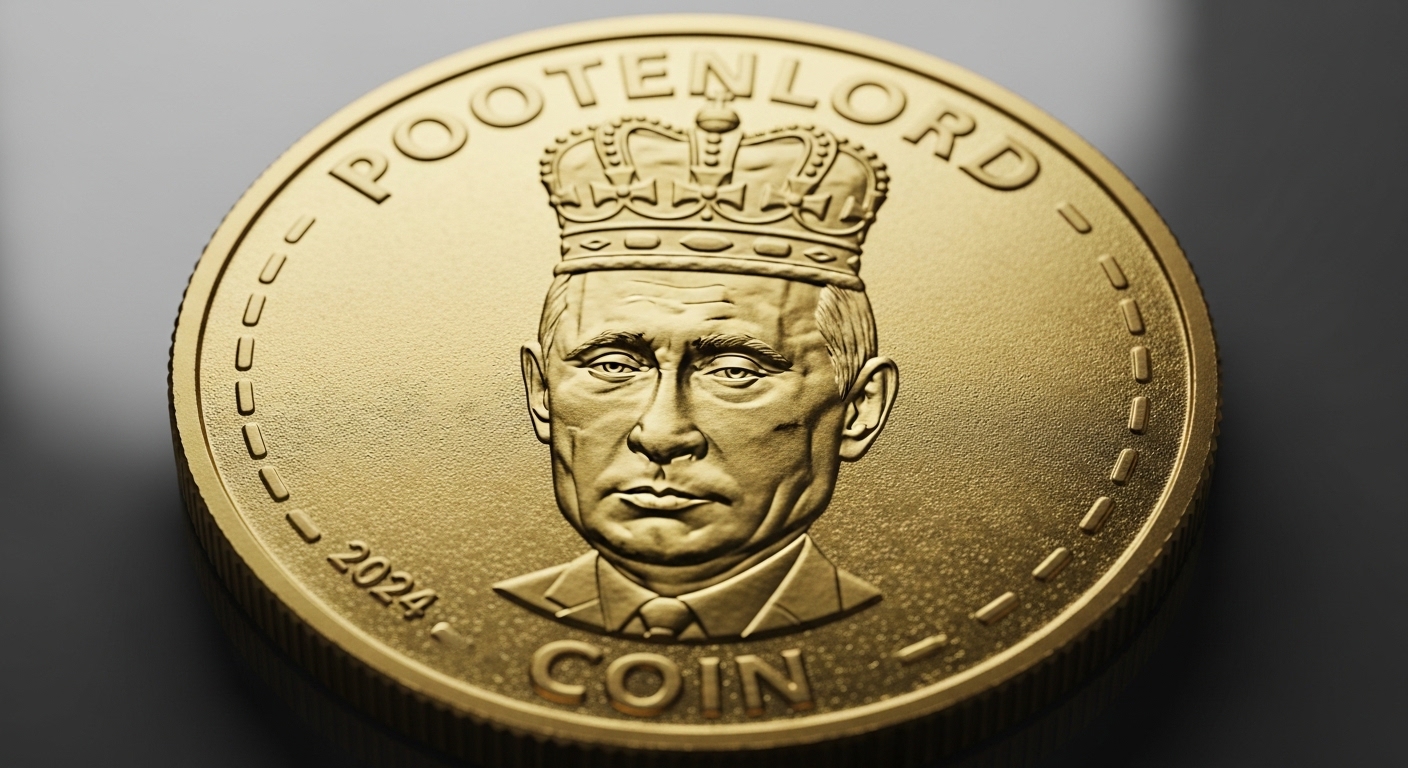
Every crypto cycle produces its share of weird, funny, and completely inexplicable tokens. Some of them disappear in 48 hours. Others against all rational expectation build real communities and outlast the serious projects that launched the same week. Pootenlord Coin ($POOTN) is somewhere in that story right now, and nobody seems to know exactly where.
This guide gives you the full picture not just what the project claims, but what the on-chain reality looks like, what the meme actually is, how the Base blockchain works in plain English, and whether there’s anything here beyond clever branding and a Twitter following. We also dig into two angles nobody else covers: how to actually verify a meme token’s safety before you touch it, and the behavioral psychology that keeps driving people toward high-risk tokens even when they know better.
Read this before you spend a single dollar on Pootenlord Coin or any meme token.
What Is Pootenlord Coin?
Pootenlord Coin ($POOTN) is a meme-based cryptocurrency that launched in January 2025 on the Base blockchain. It doesn’t claim to solve a real-world problem. It doesn’t have a traditional whitepaper or a named development team. What it has is a concept: a satirical, community-driven token built around internet humor, parody politics, and a deliberately absurd brand identity.
The project presents itself as a decentralized experiment part joke, part cultural statement, part speculative vehicle for people who find the overlap between memes and money genuinely interesting. Its branding leans hard into Russian cultural references, vodka symbolism, and the kind of grand, self-important tone that becomes funny precisely because it has no business being grand or self-important.
The token has two variants: $POOTN (the primary token) and $POO (an ICO version). The project incorporates a deflationary model meaning some tokens are periodically burned to reduce supply. In theory, this creates scarcity over time. In practice, none of this can be independently confirmed yet, because the smart contract remains unverified at the time of writing.
Key Facts: $POOTN launched January 2025 | Base blockchain | Deflationary model | Unverified smart contract | No public audit | Anonymous team
The Meme Behind the Token – Origin Story
Before there was a coin, there was a character. And before the character was a coin, it was just a genuinely funny corner of internet culture that spread faster than anyone planned.
The word “Pootenlord” is a deliberate mashup. “Pooten” is a phonetic twist on a well-known world leader’s surname, and “lord” is the kind of grandiose title that gaming communities love to hand out to whoever dominates a lobby without trying. Put them together and you get something absurd, instantly recognizable, and strangely easy to remember.
The meme spread first through gaming forums and Reddit communities, where users started crowning each other “Pootenlord” for improbably clutch moments acing a final exam without studying, pulling off an impossible trade, winning an argument with a single devastating comment. By 2025, it had moved into crypto Twitter and Telegram, where someone decided the logical next step was a token.
By December 2025, the Pootenlord name was appearing in university slang, productivity apps, and festival events. Whether that organic cultural spread translates into sustainable token value is the real question but as meme origin stories go, it’s more coherent than most.
Why Origin Stories Matter: Meme coins without a real cultural hook fade fast. $POOTN’s meme has actual roots in gaming and internet culture not just crypto-native hype. That’s a meaningful (though not sufficient) distinction.
Base Blockchain Explained Simply
If you’ve heard that Pootenlord Coin runs on Base and have no idea what that means, here’s the short version: Base is a Layer-2 blockchain built on top of Ethereum. Coinbase created and launched it. It’s designed to solve Ethereum’s main problems slow transactions and high gas fees while keeping all the benefits of Ethereum’s security and developer ecosystem.
What Layer-2 Actually Means
Ethereum’s main chain (Layer-1) processes transactions directly. This security comes at a cost: slow confirmations and expensive fees. Layer-2 networks like Base handle transactions separately bundling them together and processing them much faster and cheaper then settle the final results on the Ethereum main chain. You get speed and low cost without giving up security.
Why Base Specifically?
Base is EVM-compatible, which means any smart contract or app built for Ethereum works on Base with minimal changes. It has lower transaction fees than Ethereum mainnet, faster confirmations, and an increasingly active developer community. For a meme token that needs high-volume trading without destroying users with gas fees, Base is a practical choice.
What This Doesn’t Guarantee
Using Base doesn’t make Pootenlord Coin safe. It means the infrastructure is solid. A good foundation doesn’t validate what’s built on it. The coin could still have a compromised contract, manipulated supply, or a team planning to exit. Base is infrastructure verification of the token itself is an entirely separate matter.
Simple Version: Base = faster, cheaper Ethereum. Good for meme tokens. But choosing a good blockchain doesn’t make the token legitimate.
Tokenomics – What We Know & What’s Missing
Tokenomics is the economic structure of a cryptocurrency how many tokens exist, who holds them, how new supply enters or leaves the market, and what mechanisms drive demand. For Pootenlord Coin, the public picture is incomplete. Here’s what we can piece together:
What We Know
- Deflationary design: The project uses token burning to reduce circulating supply over time. Less supply, in theory, means each remaining token represents a larger share of whatever value the network generates.
- Community governance: Token holders are supposed to have voting rights on project decisions features, partnerships, changes. This is standard for meme coins trying to position themselves as legitimate.
- Zero presale (claimed): Some sources report the token launched with zero presale and 100% liquidity locked at launch. If accurate, this is a positive signal. If verifiable, it’s a strong one.
- Peak market cap: The token reportedly reached a peak market cap above $8 million within weeks of launch a meaningful number for a meme coin, though highly volatile and not current pricing.
What’s Missing
- No verified smart contract: Without on-chain verification, the contract’s actual supply mechanics, minting permissions, and exit controls cannot be independently confirmed.
- No third-party audit: No publicly available security audit from a reputable firm like CertiK or Hacken. This is the single largest risk factor for any meme token.
- No named development team: Anonymous teams are common in meme coins, but anonymity means zero accountability if the project fails or exits.
- No official tokenomics documentation: Supply figures, burn schedules, and distribution details are largely absent from verifiable public records.
Investor Reality Check: Incomplete tokenomics don’t necessarily mean fraud but they do mean you’re operating blind. Any investment decision made without verifiable contract data is speculation, not analysis.
How to Check If a Meme Token Is a Rug Pull – Practical Safety Guide
This is the section most Pootenlord Coin articles skip entirely. Nobody gives you the actual tools and steps to verify a meme token before you buy. Here’s how to do it, step by step.
The research is sobering. A 2025 study published in ScienceDirect analyzing tokens on decentralized exchanges found that over 98% of new tokens minted daily exhibited fraudulent characteristics. That’s not a typo. The meme coin market is genuinely hostile to uninformed retail buyers.
Step 1 – Verify the Contract Address
Before anything else, go to the official project channels (website, not a random Telegram group) and get the contract address. Then go to BaseScan (for Base chain tokens), paste the address, and check:
- Is the contract verified? A verified contract shows its source code publicly. Unverified contracts hide what the code actually does.
- When was it deployed? Days-old contracts are extremely high risk.
- Who are the top holders? If 1-5 wallets hold 40%+ of supply, that’s a concentration problem.
Step 2 – Check Liquidity Lock Status
Liquidity is what allows you to sell a token. In a rug pull, developers add liquidity to attract buyers, then remove it making selling impossible and crashing the price to zero. Use DEXTools or a Base-compatible liquidity checker to confirm:
- Is liquidity locked? Look for a time-lock contract showing LP tokens are locked.
- How long is the lock period? Days is bad. Months or years is meaningfully better.
- How much liquidity exists? Very thin pools ($10K or less) can be manipulated easily.
Step 3 – Audit the Contract Permissions
This step requires either reading Solidity code or using a tool like Token Sniffer, GoPlus Security, or DEXScreener. You’re looking for dangerous owner permissions:
- Minting authority: Can the owner create unlimited new tokens? This destroys your investment by inflating supply.
- Blacklist function: Can the owner prevent specific wallets from selling? If yes, that’s a honeypot risk.
- Fee manipulation: Can the owner change transaction fees? Some rug pulls set sell fees to 99% after launch.
- Pause trading: Can the owner freeze all trading? This traps your funds completely.
Step 4 – Analyze Community Authenticity
Open the project’s Telegram and Twitter. Don’t read what they say watch what they do. Real communities ask questions. They discuss technical concerns. They disagree occasionally. Red flags look like:
- Every post is positive. Zero critical discussion exists.
- Follower count exploded overnight with no corresponding news event.
- Questions about the contract or team get deleted or ignored.
- Engagement (comments, shares) is far below what follower count suggests.
Step 5 – Run a Token Safety Scan
Several free tools can automate a basic safety check. For Base chain tokens, use:
- GoPlus Security (gopluslabs.io) – scans for contract risks
- Token Sniffer – checks honeypot risk and liquidity status
- DEXScreener – shows real trading volume and holder distribution
Rule of Thumb: If two or more of these checks fail, walk away. If ALL checks fail, that’s not a gray area — that’s a clear warning sign.
The Unverified Smart Contract Problem – Explained Simply
The most important thing to understand about Pootenlord Coin‘s current status is this: the smart contract is unverified. Most articles mention this once and move on. But it deserves a real explanation, because most people don’t know what it actually means.
What a Smart Contract Is
A smart contract is the code that runs a cryptocurrency. It defines everything: total supply, how tokens move, who can mint new tokens, what fees get charged, and what special permissions the owner holds. On Base (like Ethereum), smart contracts are deployed publicly but they can be either verified or unverified.
The Difference Between Verified and Unverified
A verified contract has its source code published on the blockchain explorer (BaseScan) so anyone can read exactly what the code does. An unverified contract only shows machine-readable bytecode which is essentially gibberish without specialized tools. In plain terms: a verified contract is an open book. An unverified contract is a locked box.
Why This Matters for $POOTN
As long as the Pootenlord Coin smart contract remains unverified, you cannot independently confirm any of these critical facts: total token supply, whether the owner can mint unlimited new tokens, whether selling is restricted through a blacklist, what the actual fee structure is, and whether a hidden backdoor exists for draining funds. You’re trusting the team’s word. In a project with an anonymous team, that trust is entirely unanchored.
Bottom Line: An unverified smart contract is not just a technical detail. It is the central risk factor for $POOTN. Until this changes, any money put into this token is operating on faith rather than facts.
How It Compares to Dogecoin, Shiba Inu & Pepe
Every new meme coin gets compared to Dogecoin. Most of those comparisons are lazy. But the comparison is still worth making because the differences between Pootenlord Coin and its predecessors reveal exactly what stage of development $POOTN is actually at.
Dogecoin
Dogecoin launched in 2013. It has twelve years of trading history, a verified and open-source codebase, tens of millions of active wallet addresses, major exchange listings (Coinbase, Binance, Kraken), and legitimate merchant adoption. Its community didn’t just survive multiple market cycles it grew through them. Comparing $POOTN to DOGE at DOGE’s 2021 peak is misleading. The accurate comparison is $POOTN today versus DOGE in 2013-2014 which looked similarly uncertain and community-dependent.
Shiba Inu
Shiba Inu ($SHIB) went from being a pure Dogecoin joke to building a real ecosystem: ShibaSwap (a DEX), Shibarium (its own Layer-2 blockchain), and an NFT platform. The team spent years building infrastructure while the community held. That’s the trajectory that turns a meme into something with staying power. $POOTN has none of that development infrastructure yet.
Pepe ($PEPE)
Pepe is a more recent case study and the most honest comparison. It launched in April 2023 with no utility, no roadmap, and pure meme energy — and still reached a $1.5 billion market cap within weeks. The lesson Pepe teaches is that cultural resonance and virality can absolutely drive real market value. It also teaches that these moves are extremely fast, extremely volatile, and require perfect timing to profit from.
Where $POOTN Sits
Pootenlord Coin is at the earliest, highest-risk stage that all of these projects passed through. It has the meme energy and community engagement that Dogecoin and Pepe had at launch. It doesn’t have the verification, the exchange listings, the development track record, or the proven staying power. The comparison shows both the potential and the enormous distance between where $POOTN is and where successful predecessors ended up.
How to Buy & Store Safely – Step by Step
This section is informational only. It describes the process not a recommendation to buy Pootenlord Coin. Given the unverified contract status, anyone interacting with this token should only risk an amount they are fully prepared to lose entirely.
Step 1: Set Up a Compatible Wallet
Since $POOTN runs on Base, you need a wallet that supports the Base network. Two reliable options:
- MetaMask: Add the Base network manually (Chain ID: 8453, RPC URL: mainnet.base.org). MetaMask is widely supported and audited.
- Coinbase Wallet: Supports Base natively since Coinbase created Base. Easier for beginners but slightly less control.
Never use a wallet you didn’t create yourself. Never import a seed phrase from an unverified source.
Step 2: Fund Your Wallet With ETH on Base
You need ETH on the Base network to pay gas fees and to swap for $POOTN. The easiest path is buying ETH on Coinbase, then bridging to Base using the official Coinbase bridge (bridge.base.org). Avoid unofficial bridge services they’re a common vector for theft.
Step 3: Find the Verified Contract Address
This is critical. Before you swap anything, confirm the $POOTN contract address from the official project website or verified social channels not from random Telegram messages or DMs. Fake tokens with identical names but different contract addresses are extremely common. A single character difference in a contract address is all it takes to send your money to a scammer.
Step 4: Swap on a DEX
Use a decentralized exchange like Uniswap (which supports Base) or a Base-native DEX. Connect your wallet, enter the verified $POOTN contract address, and set your slippage tolerance. For volatile meme tokens, 3-5% slippage is typical. Higher slippage settings mean accepting worse prices to ensure execution.
Step 5: Store Securely
- Keep tokens in your own wallet not on an exchange.
- Write your seed phrase on paper and store it physically. Never store it digitally.
- Consider a hardware wallet (Ledger, Trezor) for any amount that would significantly hurt you to lose.
- Never share your seed phrase or private key with anyone for any reason.
Position Sizing Rule: No meme coin should represent more than 1-3% of any investment portfolio. If this coin going to zero would genuinely hurt your financial situation, you’re overexposed.
Meme Coin Investment Psychology – Why People Still Buy Risky Tokens
This is the angle nobody writes about seriously and it’s the most useful thing to understand before making any decision about meme coins. The question isn’t whether $POOTN is risky. It obviously is. The real question is: why do rational people buy risky things they know could go to zero? The answer is more interesting than “stupidity.”
FOMO Is Neurological, Not Just Emotional
FOMO Fear of Missing Out isn’t just a buzzword. Research published in Springer Nature studying cryptocurrency speculation found that FOMO and risk tolerance directly predict whether someone makes investment decisions based on emotional signals rather than rational analysis. And financial literacy — understanding crypto mechanics and market dynamics measurably reduces FOMO-driven behavior. You’re not weak for feeling FOMO. It’s a documented psychological force. But knowing it’s happening gives you a fighting chance to override it.
The Lottery Ticket Effect
Meme coins are priced at fractions of a cent. A $100 investment can buy millions of tokens. That psychological framing owning millions of something feels fundamentally different from buying two shares of a company, even if the underlying investment size is identical. The brain processes “owning 10,000,000 tokens” as inherently more meaningful than “owning $100 worth of an asset.” This is pure cognitive distortion, and meme coin projects know it.
Humor Lowers Your Guard
When something is funny, it doesn’t feel threatening. Meme coins are designed to be amusing first and financial instruments second. The absurdity of $POOTN’s branding the vodka jokes, the parody governance, the deliberately over-the-top naming creates an emotional environment where the transaction doesn’t feel like a serious financial decision. That’s a feature of the design, not an accident.
Community Is a Real Asset (and a Real Risk)
Meme coin communities create genuine belonging. Discord servers, Telegram chats, and Twitter spaces filled with people who share your references and your risks create social bonds. Those bonds feel good. They also create echo chambers. Behavioral finance research from AInvest found that 82.8% of high-return meme coins show evidence of artificial growth strategies, with institutional investors quietly exiting during hype cycles while retail communities are still cheering. The community that feels like support is sometimes the very mechanism being used to keep you buying while insiders sell.
The Regret Asymmetry Problem
People feel worse about missing a gain than they feel good about avoiding a loss of equal size. This asymmetry is one of the most documented findings in behavioral economics. When you see a meme coin go up 500% and you didn’t buy it, that pain feels real. When you avoid a coin that goes to zero, relief doesn’t register the same way. This asymmetry is why people enter meme coins at the top of hype cycles — the fear of being wrong by not buying outweighs the rational calculation of risk.
The Practical Takeaway: Understanding these psychological forces doesn’t eliminate them. But it creates a checkpoint: before buying, ask yourself which of these mechanisms you’re currently feeling. Name it. Then decide.
Red Flags Checklist Before Buying Any Meme Coin
Use this before interacting with any meme token including $POOTN. Walk through each item. If you can’t check it, treat it as a red flag.
Contract Red Flags
- Unverified smart contract: Source code is hidden from public view.
- No third-party audit: No security review from CertiK, Hacken, or similar firm.
- Minting authority not revoked: Owner can create unlimited new tokens.
- Blacklist or sell restriction functions: Owner can prevent specific wallets from selling.
- Fee functions that can be changed: Buy/sell fees can be set arbitrarily after launch.
Liquidity Red Flags
- Unlocked liquidity: LP tokens not locked can be withdrawn instantly.
- Extremely thin liquidity: Total pool under $50K is easily manipulated.
- Very short lock period: Locks of less than 30 days provide minimal protection.
Team & Community Red Flags
- Anonymous team with no track record: Not always disqualifying, but increases risk substantially.
- No whitepaper or roadmap: Projects with no documented plans have nothing to hold them accountable.
- Bot-heavy social media: Follower count that doesn’t match engagement. Delete critical comments.
- Pressure to buy urgently: “Buy now before it’s too late” messaging is a manipulation tactic.
Market Red Flags
- Supply concentrated in few wallets: Top 5 wallets holding 40%+ of supply is serious risk.
- Wash trading volume: High trading volume with no corresponding organic community growth.
- No exchange listings: Only available on obscure DEXs with zero external validation.
How to Use This Checklist: Count the flags you cannot confirm or that are clearly present. Zero confirmed red flags doesn’t mean safe it means due diligence is possible. Five or more red flags means the rational move is to walk away.
Final Verdict – Hype or Opportunity?
Let’s be direct about what Pootenlord Coin actually is in April 2026.
The Honest Case For
The meme has real cultural roots it’s not a coin that was invented to cash in on a trend. The Base blockchain choice is technically sound. The claimed liquidity lock (zero presale, 100% locked) would be a meaningful positive if independently verified. The community has demonstrated actual longevity and cross-platform presence. For a pure meme token, the origin story is more coherent than most. If the smart contract gets verified and audited, and if liquidity lock claims check out, the risk profile improves substantially.
The Honest Case Against
The smart contract is unverified. There is no public third-party audit. The team is anonymous. Tokenomics documentation is sparse. None of the key structural claims can be independently confirmed on-chain today. These aren’t minor concerns they’re the foundational safety requirements for any crypto investment, meme coin or otherwise.
What Would Change the Verdict
- Contract verification on BaseScan — the single most important step the team could take.
- A published third-party audit from a recognized security firm.
- Transparent tokenomics documentation with supply schedules, wallet distribution, and burn data.
- Major DEX or CEX listing with independent validation of the contract address.
The Bottom Line
Right now, Pootenlord Coin is a speculative bet on a meme that has cultural traction but structural opacity. If you understand meme coin markets, are allocating a small amount you’re genuinely comfortable losing completely, and have done your own contract verification — that’s your call to make. If you’re a newer investor looking for upside with manageable risk, there are better places to start. The meme is good. The verification work hasn’t been done publicly yet. That gap is the whole ballgame.
FAQs
What is Pootenlord Coin ($POOTN)?
Pootenlord Coin is a meme-based cryptocurrency launched in January 2025 on the Base blockchain. It’s a community-driven token with satirical branding, no traditional utility, and an unverified smart contract. It trades on decentralized exchanges and positions itself as a cultural experiment rather than a functional technology project.
Is Pootenlord Coin a scam?
We cannot confirm it’s a scam — and we can’t confirm it’s safe. The unverified smart contract makes independent verification impossible. That uncertainty itself is a significant risk factor. The absence of proof that it’s a rug pull is not the same as proof that it isn’t.
Where can I buy Pootenlord Coin?
$POOTN trades on decentralized exchanges compatible with the Base network. Always confirm the contract address from official channels before swapping. Fake tokens with identical names are common.
What is the total supply of $POOTN?
The exact total supply hasn’t been independently verifiable from public contract data due to the unverified contract status. The project claims a deflationary model with token burning, but these figures cannot be confirmed externally.
How is Pootenlord Coin different from other meme coins?
Its meme has genuine cultural roots outside the crypto space — originating in gaming communities and broader internet culture rather than being created specifically to launch a token. It also uses vodka-themed branding and parody governance as distinctive brand elements. These differentiate it stylistically, not structurally.
What wallet do I need for $POOTN?
Any EVM-compatible wallet that supports the Base network works. MetaMask (with Base network added manually) and Coinbase Wallet (which supports Base natively) are the most commonly used options.
Should I invest in Pootenlord Coin?
This article does not provide investment advice. The practical answer is: not without verified contract data, a public audit, and a position size you could lose entirely without financial stress. Anyone telling you otherwise is either speculating or selling something.
What happens if the smart contract never gets verified?
If the contract remains unverified indefinitely, the token’s risk profile stays permanently elevated. It would limit institutional interest, discourage exchange listings, and keep serious investors away. The project would rely entirely on community momentum which eventually fades without structural credibility.