
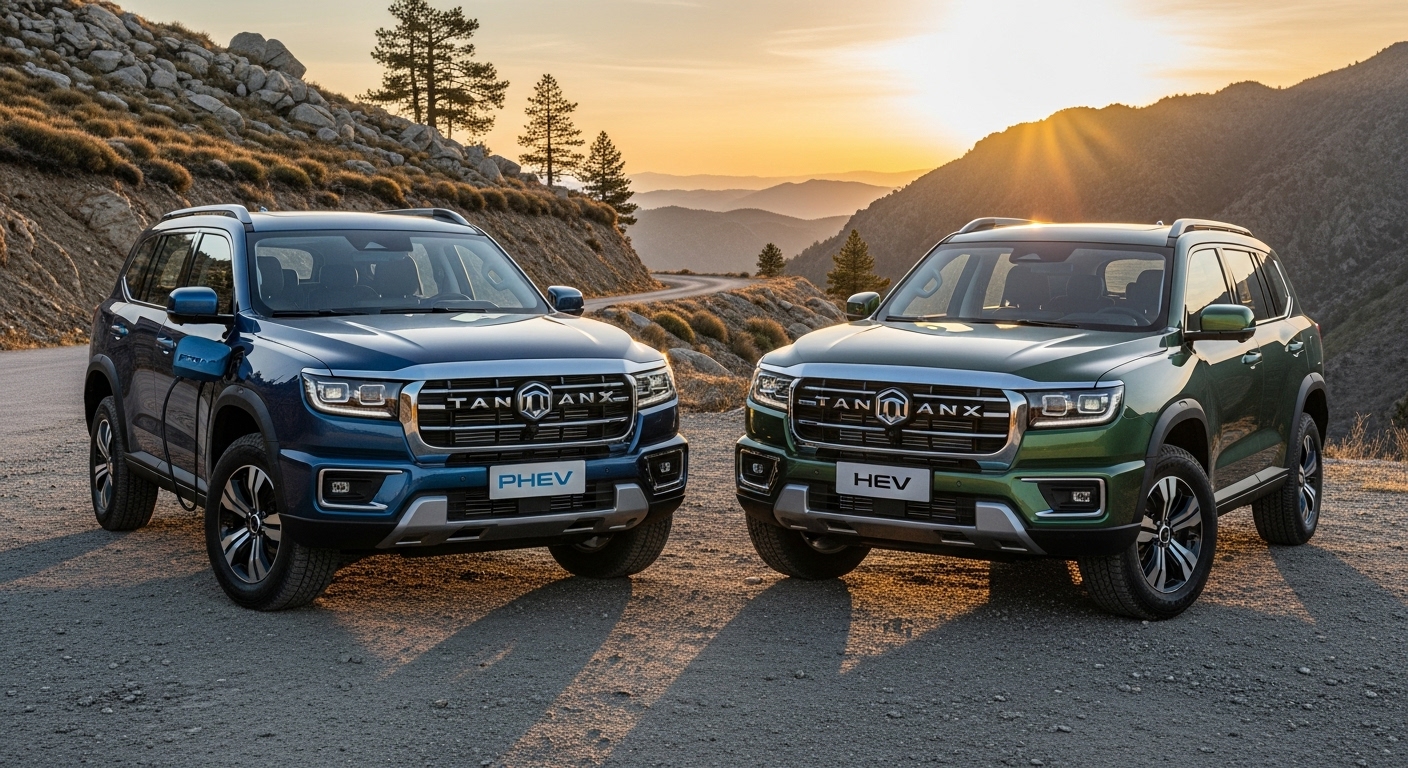
The GWM Tank 500 PHEV and HEV are hybrid variants of Great Wall Motor’s premium SUV, combining electrified efficiency with rugged capability and luxury features.
This full-length guide explores everything known about the Tank 500 PHEV and HEV from engineering and performance to pricing, features, off-road ability, and how it stacks up against competitors. Although its commercial focus has centered on markets like Asia, the Tank 500’s technology and SUV philosophy offer insight into a rapidly evolving segment of electrified luxury SUVs.
A New Breed of Electrified Full-Size SUV
The GWM Tank 500 represents a shift in Great Wall Motor’s global ambition. Traditionally known for rugged, body-on-frame SUVs and pickup trucks popular in Asia and other emerging markets, GWM has pivoted toward electrification without sacrificing capability. The introduction of both Hybrid Electric Vehicle (HEV) and Plug-In Hybrid Electric Vehicle (PHEV) variants underscores this transition, offering options that balance fuel efficiency, electric driving, and traditional SUV strength.
The Tank 500 lineup is designed to challenge long-standing SUV players by combining hybrid technology with premium features, off-road DNA, and modern safety systems. This blend of attributes offers buyers a compelling alternative to conventional SUVs that either focus solely on electrification or retain traditional internal combustion powertrains.
Design and Engineering: Rugged Meets Premium
At the heart of the GWM Tank 500’s appeal lies its advanced hybrid powertrains, designed to merge brute force with efficiency in a segment dominated by thirsty V8s and diesels. The HEV variant combines a 2.0-liter turbocharged petrol engine with a single electric motor for a total 255 kW (342 hp) and 648 Nm, sent through a 9-speed automatic to all four wheels. This non-plug-in system excels in seamless transitions, where the electric boost fills turbo gaps for instant response, achieving 0-100 km/h in 8.3 seconds quicker than many rivals while sipping fuel at a claimed 8.5 L/100 km combined, though real-world mixed driving often lands around 10-12 L/100 km with loads or highways.
The PHEV steps it up dramatically with dual electric motors (one per axle), a larger 37.1 kWh NMC battery, and the same petrol mill, yielding 300 kW (402 hp) and a class-leading 750 Nm. Plug it in for 102-120 km WLTP pure EV range on a full charge enough for daily commutes without petrol and total range exceeds 950 km with the 70-liter tank. Fast DC charging hits 80% in 24 minutes, AC takes 6.5 hours, and low-battery efficiency hovers at 10.2 L/100 km in tests, making it a game-changer for urban explorers who hate fuel stops. Both feature 11 drive modes, low-range transfer case, and torque vectoring, but the PHEV’s extra grunt transforms it into a torque monster for overtakes or climbs.
Build and Off-Road Credibility
No monocoque unibody here the Tank 500 rides a traditional ladder-frame chassis with double-wishbone front and multi-link rear suspension, underpinning its 5,078 mm length, 2,850 mm wheelbase, and 213 mm ground clearance. Approach (30°), breakover (22.5°), and departure (24°) angles rival the Toyota Land Cruiser Prado, backed by full-time 4WD, three locking diffs, and 800 mm wading depth for serious trails. Off-road reviewers note its poise on ruts and rocks, where hydraulic body control (standard on Ultra trims) keeps wheels planted, though the PHEV’s 2,850 kg heft and battery location slightly compromises rear articulation versus lighter petrol foes.[ from prior]
Dimensions scream presence: 1,934 mm wide, 1,905 mm tall, with 265/50 R20 alloys and side steps for easy access. Adaptive dampers smooth potholes on tarmac, while tank-like build quality steel underbody shields, high-strength alloys promises durability in Thailand rough terrains, from Kaghan valleys to Makran coast dunes. Towing maxes at 3,000 kg braked, plenty for trailers or boats, with trailer sway control standard.
Luxe Interior and Daily Comfort
Step inside, and the Tank 500 punches luxury credentials with quilted Nappa leather, massaging/heated/vented front seats (memory for driver), and heated rears. The 5-seater PHEV (7 optional on HEV) offers 795 liters boot space, folding to 2,000+ liters, with powered tailgate and air suspension for level loading. Dual-zone climate, ambient LEDs, panoramic sunroof, and wood/aluminum trim create a serene cocoon, far removed from budget Chinese stereotypes.
Tech overload includes a 14.6-inch floating touchscreen (wireless CarPlay/Android Auto, OTA updates), 12.3-inch digital cluster, HUD, and 12-speaker Infinity audio. Wireless charging, V2L outlets (3 kW external power for campsites), and 360° cameras with transparent mode make it family-ready. Third-row access is tight but viable for kids, and the boss-mode rear controls add VIP flair think cooled cupholders and fold-out tables.
Safety Suite and Reliability Notes
GWM loads on 10+ airbags, AEB, adaptive cruise, lane-keep/centring, blind-spot cams, and rear cross-traffic braking, plus night vision and driver monitoring. ANCAP-equivalent 5-star potential shines in global tests, with reinforced frame and run-flat tires for peace of mind. Early Thailand units show solid build, but long-term hybrid battery warranties (8 years/160,000 km) will be key as local assembly ramps up.
Powertrain Breakdown: HEV vs. PHEV
The Tank 500 comes in two distinct hybridized powertrain options, each tailored to different driving priorities:
Hybrid Electric Vehicle (HEV)
The Tank 500 HEV integrates a 2.0-liter turbocharged petrol engine with an electric motor in a self-charging hybrid configuration. This setup produces around 246 horsepower and 648 Nm of torque, paired to a 9-speed automatic transmission with full-time four-wheel drive. The HEV prioritizes smooth acceleration and fuel efficiency without requiring external charging.
Plug-In Hybrid Electric Vehicle (PHEV)
The PHEV variant builds on the HEV platform with a larger battery and dual electric motors, enhancing both performance and electrified range. It delivers a combined power output of approximately 402 horsepower and 750 Nm of torque, along with an EV-only driving capability of approximately 80–100 km (WLTP). This electric range allows for significant daily commuting on electric power alone, reducing fuel usage overall when used optimally.
The PHEV’s battery is reported to be around 37.11 kWh, which supports both AC and DC fast-charging a notable advantage for buyers who want short electric trips and long-distance hybrid efficiency seamlessly integrated.
Performance and Capability
While many hybrid SUVs focus on efficiency over performance, the Tank 500’s electrified variants maintain the brand’s commitment to capability. The HEV, with its robust torque output, handles everyday driving with confident acceleration and capable towing potential. On the other hand, the PHEV’s added electrification boosts both punch and responsiveness, enabling stronger launch performance and electrified cruising.
The body-on-frame design complements this powertrain versatility by providing a stable platform for off-road conditions. Advanced driving modes, including snow, sand, and sport, help adapt the vehicle’s dynamics to varied terrain something consumers in many markets value highly. Off-road enthusiasts will also find traditional SUV traits like high ground clearance and rugged structural design reassuring when navigating unpaved surfaces.
Pricing Snapshot: What Buyers Can Expect
Although the Tank 500 is not widely marketed in the U.S. as of early 2026, its pricing in other markets like Thailand offers useful context for its positioning and value proposition. In Thailand locally assembled market, the HEV variant is priced at approximately $77,990, while the PHEV sits at around $80,000 (ex-factory prices).
Here’s a concise price reference based on these figures:
| Variant | Ex-Factory Price ($) | Key Value Proposition |
|---|---|---|
| Tank 500 HEV | $77,990 | Efficient hybrid power with 7-seater practicality |
| Tank 500 PHEV | $80,000 | Higher performance and EV-capable range |
Note: Currency and pricing will vary significantly in global markets beyond Thailand.
These prices indicate that the Tank 500 competes in a premium SUV bracket, where hybrid efficiency and luxury features are prioritized. The PHEV variant, in particular, aims at buyers who want the flexibility of electric-only driving for daily use without forgoing the long-distance range assurance of a combustion engine hybrid.
Feature Overview: Safety, Tech, and Comfort
Both Tank 500 variants come well-equipped in terms of safety and driver assistance technology. Standard features include advanced ADAS suites with adaptive cruise control, automated emergency braking, blind spot monitoring, lane-keeping assist, and 360-degree cameras systems increasingly expected in premium SUVs. These technologies enhance both highway and urban driving confidence.
Comfort features reflect a clear intention to appeal to buyers seeking refinement. The inclusion of Nappa leather, seat ventilation and memory functions, panoramic sunroof, and premium sound systems shows that GWM has studied what competing luxury brands offer and strategically closed the gap. The addition of active noise cancellation further elevates the cabin experience, especially at highway speeds.
Comparison with Key Global Rivals
A vehicle like the Tank 500 naturally invites comparison with other large SUVs in the hybrid and electrified segments. While direct competitors may vary by market, the following parallels help frame its appeal:
-
Toyota Land Cruiser (Hybrid variants): Known for legendary durability and off-road prowess, the Land Cruiser hybrid offers reliability but at significantly higher price points in many markets.
-
Ford Explorer Hybrid: A well-rounded hybrid SUV with widespread service networks in the U.S., but less premium interior fitment than the Tank 500.
-
Jeep Grand Cherokee 4xe: A plug-in hybrid with strong off-road heritage, competing on performance and trail capability but often at a higher cost.
-
Range Rover PHEV: Combines luxury and electrified power but commands a premium price reflective of the brand’s luxury status.
Compared to these rivals, the Tank 500’s strategy is to offer a rich feature set, off-road capability, and hybrid efficiency at competitive pricing, especially in markets outside the U.S. where it is officially sold. Its value proposition centers on technology and comfort that punches above expected price levels, a strategy that has helped Chinese automotive brands expand their global footprint.
Who Should Consider the Tank 500?
The Tank 500 PHEV and HEV are best suited for buyers who want:
-
A spacious SUV with hybrid efficiency and utility
-
A blend of off-road capability and everyday comfort
-
Advanced safety and driver assistance systems
-
Premium design touches without entering ultra-luxury pricing tiers
Their hybrid powertrains provide flexibility for both fuel-efficient commuting and longer journeys, while full-time 4WD systems support confident handling across diverse conditions. These strengths make the Tank 500 viable for families, adventure seekers, and tech-oriented buyers who want a modern SUV that doesn’t skimp on features.
Final Take: A Worthy Contender in Electrified Luxury SUVs
The GWM Tank 500 PHEV and HEV for 2026 present a compelling argument that hybrid powertrains can coexist with rugged capability and premium comfort. While it remains primarily focused on markets like Thailand and parts of Asia, the Tank 500’s global engineering and feature set reflect broader trends in the SUV segment: electrification, connectivity, luxury touches, and versatile performance.
Buyers looking for a modern SUV that blends these elements without the premium pricing of some legacy brands will find the Tank 500’s philosophy hard to ignore. As GWM continues to expand internationally, vehicles like the Tank 500 could reshape expectations for hybrid SUVs and influence how global buyers define value in the electrified era.
