
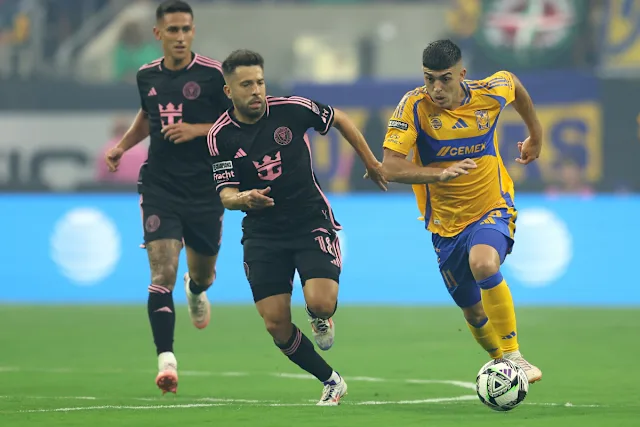
There are games you watch and forget by morning. Then there are games like this one.
Inter Miami’s 2–1 win over Tigres UANL on August 20, 2025 at Chase Stadium was a masterclass in chaos management a match that had it all: a manager getting sent to the stands, two controversial VAR handball calls, a star forward playing the hero role without his famous partner, and a dramatic header off the post in stoppage time that nearly ripped the win away at the last second.
Lionel Messi didn’t play. Javier Mascherano got a red card before halftime. And yet, Inter Miami reached the Leagues Cup semifinals. How? That’s exactly what these inter miami vs tigres uanl player ratings are here to answer not just who got what number, but why, and what it actually means tactically.
Let’s get into it.
Match Overview: How the Game Unfolded
Miami came out sharp. They set up with a high press that Tigres genuinely struggled to play through in the opening half-hour. The pressure was suffocating Tigres couldn’t string passes together, and Miami’s midfield was winning second balls all over the pitch.
The first goal came from that pressure. In the 23rd minute, Telasco Segovia whipped in a cross and Javier Aquino’s arm got in the way. The referee went to VAR, and after a review, awarded the penalty. Luis Suárez ice-cold as ever buried it.
Then everything started unraveling. Mascherano, who had been animated on the sideline all night, got caught up in a confrontation near the touchline and was shown a red card just before halftime. Suddenly, Miami were going into the second half a man down.
Tigres smelled blood. They pushed higher, their midfield got on the ball more, and in the 67th minute Ángel Correa the best player on the Tigres roster by a wide margin picked up a poor turnover from Gonzalo Luján, drove past two Miami defenders, and finished cleanly past Óscar Ustari. It was an equalizer that Tigres fully deserved at that stage of the match.
But Miami didn’t crack. With five minutes left, Rodrigo De Paul drove into the box and hit a shot that deflected off Aquino’s arm again. Another VAR check, another penalty. Suárez stepped up, sent the keeper the wrong way, and that was the game. Almost. In stoppage time, Iván López headed the ball onto the post, then onto the other post, and somehow it didn’t cross the line. Ustari gathered and Miami held on.
Final score: Inter Miami 2, Tigres UANL 1.
Inter Miami Player Ratings
Starting XI
| Player | Position | Rating | Key Contribution |
|---|---|---|---|
| Óscar Ustari | GK | 7/10 | Solid saves, well-positioned for most of the match |
| Jordi Alba | LB | 7/10 | Overlapping runs, aggressive in the press |
| Maximiliano Falcón | CB | 6/10 | Steady but caught out during Correa’s goal |
| Gonzalo Luján | CB | 5/10 | Costly turnover directly led to Tigres’ equalizer |
| Ian Fray | RB | 6.5/10 | Drew 4 fouls, energetic but inconsistent defensively |
| Sergio Busquets | CM | 8/10 | Controlled the first half, became Miami’s on-field organizer post red card |
| Rodrigo De Paul | CM | 7.5/10 | Provided creativity and won the second penalty |
| Yannick Bright | RW | 7/10 | Speed stretched Tigres defensively, crossing was hit or miss |
| Telasco Segovia | LW | 7/10 | Delivered the cross that won the first penalty |
| Tadeo Allende | CAM | 6/10 | Largely anonymous before being subbed off |
| Luis Suárez | FW | 9.5/10 | Two penalties, MOTM, composed and clutch when it mattered most |
Substitutes
| Player | Rating | Notes |
|---|---|---|
| Noah Allen (CB) | 7/10 | Solid defensive cover post red card, brought stability off the bench |
Tactical Deep-Dive: How Mascherano’s Red Card Changed Everything
This is the angle every other ratings piece skipped over completely and it’s the most important tactical story of the match.
Before Mascherano was sent to the stands, Miami were playing a structured 4-2-3-1. Busquets and De Paul sat in a double pivot, the press was coordinated, and Tigres had no answers. Miami looked like the better team in every department.
After the red card? Everything shifted.
Miami dropped into a compact 4-4-1 shape. The press was abandoned entirely. The team sat deep, defended in two narrow blocks of four, and looked to transition quickly on the counter. It was smart, disciplined football and it was clearly being directed by Busquets, who became the de facto organizer on the pitch with his manager stuck in the stands.
Busquets had nine first-half touches in the opposition half. After the red card, he dropped ten yards deeper, barely crossed the halfway line, and instead became a quarterback positioning teammates, setting the defensive line, managing the clock. That first-half 9/10 performance shifted to something more controlled and less flashy, but arguably just as valuable.
De Paul’s role also changed. He went from a box-to-box engine in the first half to a disciplined right midfielder who tracked back, won the ball, and made simple passes. The shot that won the second penalty was one of his few moments of attacking freedom in the second half. He took it perfectly.
It was Mascherano’s tactical identity on the pitch without Mascherano on the sideline. And it worked.
Tigres UANL Player Ratings
| Player | Position | Rating | Key Contribution |
|---|---|---|---|
| Nahuel Guzmán | GK | 6/10 | Beaten by both penalties, didn’t go the right way on either |
| Javier Aquino | RW | 4/10 | Two handball penalties directly responsible for both Miami goals |
| Defensive line | – | 6/10 | Held firm for stretches but couldn’t fully neutralize Miami’s threats |
| Juan Brunetta | CM | 7/10 | Competitive, drew fouls, found pockets of space in the second half |
| Fernando Gorriarán | CM | 7/10 | Tried to drive Tigres forward, better in the second half |
| Ángel Correa | FW | 8/10 | Leagues Cup-leading 5th goal, dangerous every time he touched the ball |
| Ozziel Herrera | FW | 6/10 | Four shots but struggled to create real scoring chances |
| Iván López | – | 6.5/10 | Nearly the hero hit the post with a header in stoppage time |
Aquino’s rating is what it is. Two handball penalties in the same game is impossible to paper over with otherwise solid defensive work. The man was the deciding factor in the match in the worst possible way for Tigres.
The Messi Factor: Did His Absence Actually Change How Miami Played?
This is a question most outlets ignored, and it shouldn’t be.
When Messi plays, Inter Miami are a possession-dominant, technically precise team. The ball moves to him, everything funnels through him, and the structure bends around his gravity. Per FBref’s 2025 season data, Miami’s average possession sits above 55% in matches where Messi starts.
Against Tigres? Miami had 40.3% possession. That’s not a coincidence.
Without Messi, Miami couldn’t hold the ball in the final third. They couldn’t pin Tigres back with patient build-up play. So Mascherano leaned into a different identity high press, direct transitions, set-piece threats. It was a deliberate tactical pivot, not a plan B. And three players stepped into expanded roles as a direct result.
Suárez became the focal point. Rather than running off Messi’s vision, he had to hold the line himself, draw defenders, and be clinical when his moment came. He was.
De Paul became the primary creator. In a Messi team, De Paul is the energy pressing triggers, winning balls, linking play. Without Messi, he had to be the player who actually made things happen in the final third. His shot winning the second penalty was the biggest play of his night.
Busquets became the decision-maker. With no Messi to control the tempo in higher areas, Busquets sat deeper and owned every ball that came his way. His 9/10 first-half performance was genuinely outstanding the kind of display that doesn’t make highlight reels but absolutely wins games.
VAR Controversy: The Two Aquino Handballs Explained
Let’s address this directly, because the social media reaction was predictably loud.
The first handball Segovia’s cross hit Aquino’s outstretched arm at the 23-minute mark. Under current Laws of the Game, a ball striking an arm that is in an unnatural position above shoulder height is a penalty regardless of intent. Aquino’s arm was raised and away from his body. The VAR review confirmed the call. It was correct.
The second handball, in the 85th minute, was even more clear-cut. De Paul’s shot struck Aquino’s arm at close range with his arm extended. Again unnatural position, clear contact, penalty awarded.
Were both unlucky? Probably. Aquino wasn’t necessarily trying to handball either time. But the rule doesn’t require intent. As UEFA’s official Laws of the Game documentation makes clear, the criteria is arm position, not deliberate action.
The psychological impact was visible. After the second penalty was awarded, Tigres players surrounded the referee, arguing for nearly two minutes. That emotional spike cost them their defensive shape for the final minutes and nearly cost them a leveler when López’s header hit both posts before Ustari grabbed it.
Correa’s response, however, was the opposite of emotional. He kept driving, kept making runs, kept being a constant threat. That says a lot about his mentality.
Player of the Match: Luis Suárez Analysis
Let’s be honest the numbers tell the story here.
- 5 shots, 3 on target
- 2 goals (both penalties)
- 2 fouls committed
- Completed 87% of his passes
But the stat that matters most isn’t in any box score. Suárez took two match-defining penalty kicks the first in front of a hostile Tigres contingent after a disputed VAR call, the second with the game tied at 1–1 and five minutes left and he converted both without blinking.
The first penalty: bottom left corner. Guzmán didn’t move.
The second penalty: same side, same composure, game over.
This is a 38-year-old forward playing in a competition that matters without his best teammate, with his manager watching from the stands, in a match that was genuinely chaotic for large stretches. He delivered anyway.
Suárez’s record in 2025 shows a player who has extended his career not through athleticism, but through positioning, reading the game, and being available at the right moments. Against Tigres, he was everything Miami needed him to be.
Key Match Stats
| Stat | Inter Miami | Tigres UANL |
|---|---|---|
| Possession | 40.3% | 59.7% |
| Shots | 14 | 13 |
| Shots on Target | 4 | 2 |
| Goals | 2 | 1 |
| Yellow Cards | 2 | 1 |
| Corner Kicks | 4 | 3 |
| Fouls Committed | 8 | 15 |
| Saves | 1 | 2 |
| Attendance | 18,597 | – |
The possession stat is worth sitting with. Tigres had almost 60% of the ball. They had 13 shots. They hit the post in the final minute. And they still lost. Miami’s defensive structure especially after going to ten men was exceptional.
What This Win Means for Inter Miami’s Leagues Cup Run
Reaching the semifinals of a tournament like Leagues Cup without your best player, with your coach sent off at halftime, while conceding 60% possession that’s not lucky. That’s a team with depth, character, and a system that works even when the plan falls apart.
What’s genuinely interesting is what this result reveals about Mascherano’s coaching philosophy. He is building a team that can absorb pressure and hit you on the transition not just a team that plays pretty football with Messi pulling the strings. Without Messi, Miami are a different team. But they’re still a dangerous one.
Going forward, Miami will face either Toluca FC or Orlando City in the semifinals on August 26–27. Whether Messi returns remains unclear. But based on this performance, the rest of the Leagues Cup bracket should be concerned regardless.
Frequently Asked Questions
Q: Who scored for Inter Miami vs Tigres UANL? Luis Suárez scored both goals for Inter Miami, both from the penalty spot in the 23rd minute and 89th minute. Ángel Correa scored for Tigres in the 67th minute.
Q: Why was Mascherano sent off vs Tigres? Inter Miami manager Javier Mascherano was shown a red card just before halftime after getting involved in a confrontation near the touchline following the first penalty decision. He watched the second half from the stands, reportedly communicating with his assistant coach by phone.
Q: What was the final score of Inter Miami vs Tigres UANL? Inter Miami won 2–1. The match was played on August 20, 2025 at Chase Stadium in Fort Lauderdale as part of the 2025 Leagues Cup quarterfinals.
Q: Who was the best player in Inter Miami vs Tigres UANL? Luis Suárez was the clear Player of the Match with two penalties and a composed, leadership-driven performance. Sergio Busquets deserves an honorable mention for his tactical control of the first half and his calm organizing role after Miami went to ten men.
Q: Did Messi play vs Tigres UANL? No. Lionel Messi was absent for this match. He had been nursing a hamstring injury and did not feature in the quarterfinal.
Final Word
This match had every ingredient for disaster from Miami’s perspective. Their manager was in the stands. Their best player was in a tracksuit watching from home. Their opponent had the ball for most of the second half.
And yet they won.
The inter miami vs tigres uanl player ratings tell a very specific story: one man (Suárez) was the difference on the scoresheet, one player (Aquino) made two costly handball errors, and one tactical framework (Mascherano’s disciplined low-block in the second half) held everything together when it should have crumbled.
For all the chaos, this was a team performance. It just needed one player to be ice-cold twice when it counted. Luckily, they had exactly the right person for that job.
What Is Insoya? Benefits, Nutrition & Why It’s Trending
Discover why Insoya is gaining popularity in plant-based diets and how it can boost your health.